Granite is hard, abrasive and silica-rich, so the circuit you pick controls wear life, product shape and dust exposure.
Say a mine owner asks how to set up a granite crushing circuit for railway ballast and concrete aggregate. They know the rock is hard. What they often miss is that granite’s hardness and quartz content don’t just make it tough on equipment. They force a specific circuit architecture: jaw primary, cone secondary and tertiary, and closed-circuit screening. Get that wrong and you’ll be fighting liner wear, silica dust and off-spec gradations from the first day.
What makes granite different from other crushed rock
Granite is an igneous rock with high quartz content. That quartz drives two things: high compressive strength and severe abrasion. Limestone, by comparison, is softer and far less abrasive. If you’re coming from a limestone plant, the differences are stark; see our limestone crushing guide for the softer-rock case.
In 2025, granite accounted for roughly 14 per cent of crushed stone produced in the United States, according to the USGS Mineral Commodity Summaries. That share reflects granite’s role as a premium aggregate source. But the same properties that make granite desirable also make it hard on machines. A jaw crusher can handle it. An impact crusher, as a primary, generally cannot. Granite’s abrasive silica particles rip through impact bars and blow bars at a punishing rate. Compression crushing is the only sensible starting point.
So the first rule for granite is simple: don’t put an impactor on primary duty unless you enjoy replacing wear parts every shift.
| Property | Granite | Limestone | Circuit implication |
|---|---|---|---|
| Hardness | High | Moderate to low | Compression crushing needed |
| Abrasiveness | High due to quartz | Low to moderate | Wear parts wear faster |
| Primary crusher | Jaw | Impact or jaw | Impactor unsuitable for granite primary |
| Silica dust | Significant | Lower | Dust control mandatory |
The standard granite circuit: jaw primary plus cone secondary and tertiary
EPA AP-42 section 11.19.2 notes that jaw, impactor or gyratory crushers are usually used for initial reduction. For granite, the jaw wins. Its compression action handles the high feed forces and hard rock without the violent wear an impactor would suffer. A jaw crusher’s geometry also lets you feed large blocks: the feed opening is sized from the top size in the shot rock.
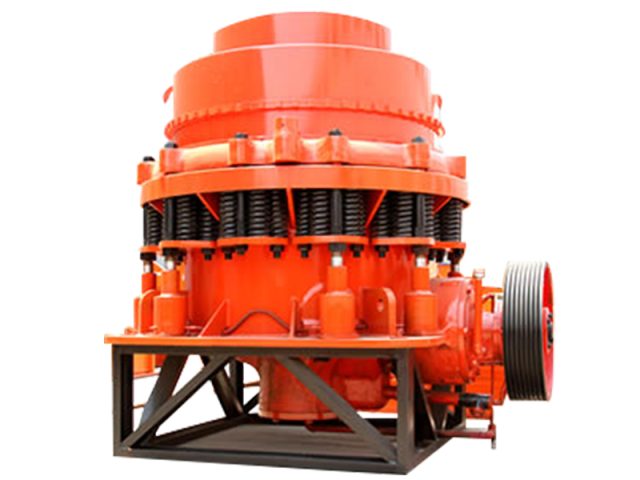
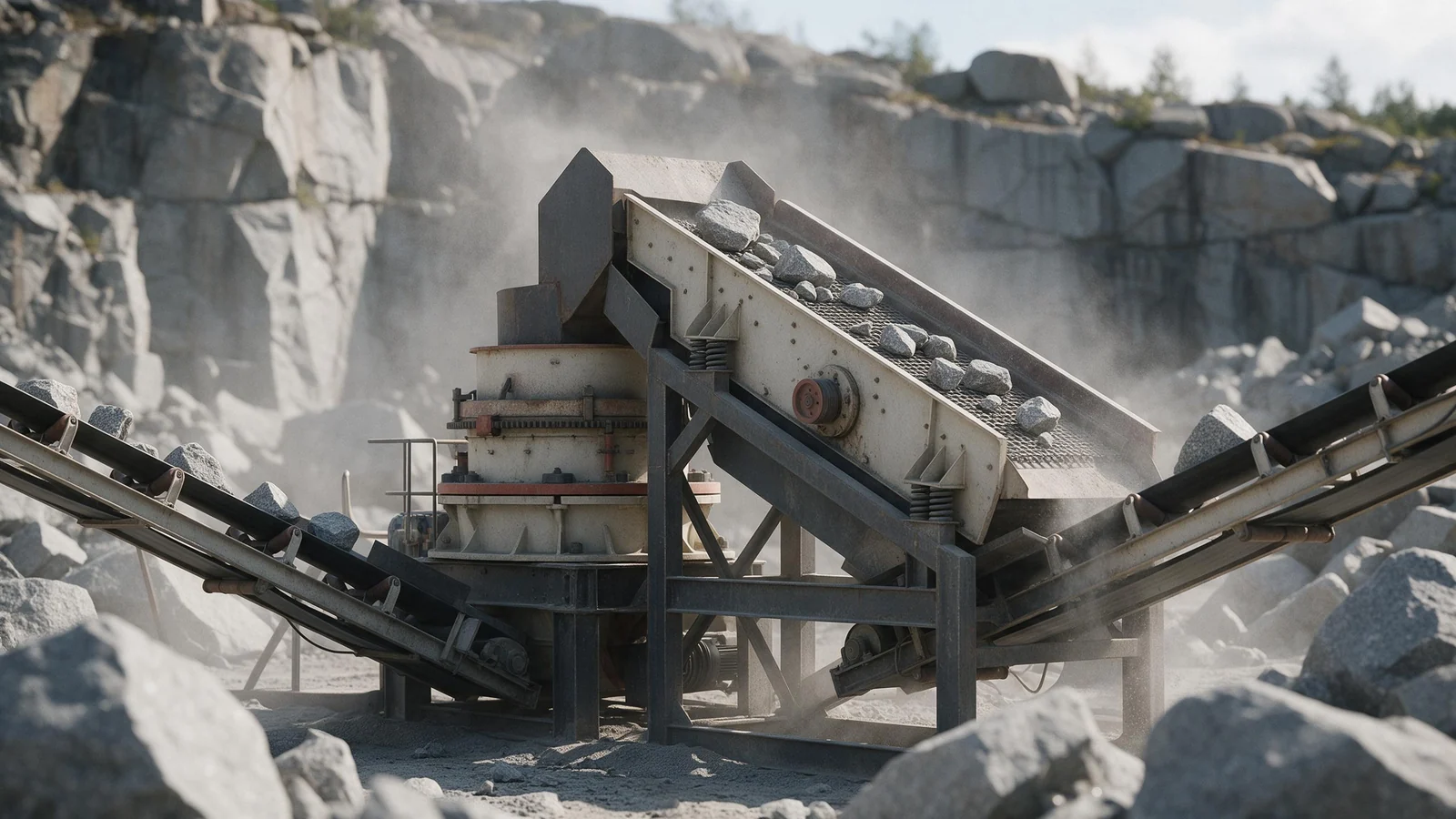
After the jaw, cone crushers take over. The same EPA document confirms that cone crushers are commonly used for secondary crushing. A cone’s interparticle compression gives you better reduction ratios and a more cubical product than further jaw reduction. Tertiary crushing then uses cone crushers or, where shaping is critical, a vertical shaft impactor.
This is a compression crushing circuit, not an impact circuit. The full crushing equipment range is covered in our crushing equipment guide, but the architecture for granite is settled: jaw first, cone second, cone or VSI third. Always screen between stages. Always.
Granite crushing stages and the equipment in each
Primary crushing takes blast rock down to a size a secondary crusher can swallow. For granite, that’s a heavy-duty jaw crusher set to produce a top size around 200 to 300 mm, depending on your feed opening. Secondary crushing, usually a cone crusher, reduces that further to a 50 to 80 mm top size. Tertiary crushing, another cone or a fine jaw, produces the final fractions that go to screening. If you need a cubical product for concrete or railway ballast, a vertical shaft impactor can shape the particles. But VSI is not a reduction machine for hard granite; it is a shaping machine, and it should sit after the cones, not before them.
Each stage changes the feed and discharge size range. The buyer’s job is to specify those ranges from the product specification, then ask the crusher supplier to confirm the machine can achieve them at the required throughput. Don’t size a crusher from a brochure table alone. Granite’s hardness and abrasiveness mean the actual throughput will usually sit below the catalogue number.
Closed-circuit screening and target gradations
After every crushing stage, screening separates product from oversize. In a closed circuit, oversize returns to the same crusher. That loop is what controls top size. Open circuit gives you too much oversize; closed circuit gives you consistency. Granite’s toughness makes closed circuit more important, not less, because you cannot afford to send off-spec material to the next stage.
Railway ballast and concrete aggregate need different screens even from the same granite feed. Ballast specifications demand a narrow size band, often a single particle size class with tight tolerances, because the void space between particles must stay uniform. Concrete aggregate follows ASTM D448 size designations and standard ranges. The screen apertures, deck arrangement and circulating load all change when you switch from ballast to concrete stone. Same rock, different flowsheet.
The screen itself must cope with granite dust and moisture. Useful variables include aperture size, deck angle, amplitude and screen cloth material. For granite, polyurethane or rubber panels often outlast woven wire cloth because they resist abrasion better. That’s a wear decision, not just a sizing decision.
Wear parts, maintenance and operating cost in granite service
Granite eats liners. There’s no way around that. The higher the quartz content, the faster the manganese wear parts degrade. A cone mantle that lasts six months in limestone might need replacement in two or three months in granite, depending on the ore. For that reason, impact crushers become expensive quickly: the blow bars and liners see every hard particle at high velocity. Cone and jaw liners wear more slowly because the crushing action is slower and compressive.
Plan maintenance around liner change-outs, not just calendar hours. Keep a spare mantle and bowl liner on site. Budget for more frequent screen cloth replacement too. Our cone crusher parts guide goes into the details of manganese grades and liner profiles, but the operating rule for granite is blunt: abrasive rock makes wear parts a controlled expense, not an afterthought.
Dust and respirable silica control in granite crushing
High quartz content means high respirable crystalline silica. When granite is crushed, the fine material becomes airborne at transfer points, screens and crusher discharges. OSHA’s silica standard sets a permissible exposure limit, and every granite crushing operation needs a written dust control plan to stay below it. Water sprays at feed and discharge points knock down visible dust. Enclosures and local exhaust ventilation capture what water cannot. Regular housekeeping stops settled dust from becoming airborne again.
Don’t treat silica dust as a nuisance. It’s a regulatory and health liability. You’ll need air monitoring, worker training and records. The dust control system is part of the circuit, not an optional bolt-on. A dry granite plant can produce excellent product, but only if the dust stays where it belongs.
What to specify before you buy a granite crushing circuit
No reputable supplier can size a granite circuit without certain inputs. These are the rock data, product targets and operating parameters that drive every selection from the jaw opening to the screen cloth. If a supplier quotes a circuit without seeing these, walk away.
- Uniaxial compressive strength test result in MPa, from the actual deposit
- Abrasion index or bond work index, if available
- Feed top size, including the largest block the primary will see
- Moisture content and clay content in the feed
- Target product gradations for each saleable fraction
- Required throughput in tonnes per hour, including future expansion
- End use: railway ballast, concrete aggregate, asphalt stone or manufactured sand
Once you have these, the circuit selection becomes logical. Our crushing plant cost guide explains the capital and operating trade-offs from there. For a complete plant, Xinhai reports more than 600 mine EPC+M+O projects, according to the company’s published figures. Xinhai’s mine design institute designs to JORC, NI 43-101, VALMIN, GB, Eurocodes, US and Australian standards. That kind of standardised engineering matters when you’re feeding an abrasive rock like granite.
Frequently Asked Questions
What is the crushing strength of granite?
Granite is a hard, abrasive igneous rock with high compressive strength. The exact value depends on the deposit's mineralogy and weathering, so a buyer should ask for uniaxial compressive strength test results from the specific quarry. That data, not a textbook range, drives crusher selection and liner expectations.
What can you do with crushed granite?
Crushed granite is used mainly as construction aggregate for roads and concrete, as railway ballast, and for other high-strength aggregate products. The USGS notes that most crushed stone in the United States goes to construction aggregate, and granite's hardness makes it suitable where a durable stone is required.
How do you grind down granite?
You don't start by grinding granite. You crush it. A jaw crusher handles the primary reduction, then cone crushers take over for secondary and tertiary stages. If you need fine manufactured sand or a cubical shape, a vertical shaft impactor can shape the particles after the cones. Actual grinding, as in a mill, is unnecessary for most aggregate products.
What is the difference between jaw and cone crushing for granite?
A jaw crusher is the primary machine. It accepts large feed blocks and uses compression to break hard granite. A cone crusher works on already reduced material and provides better interparticle compression, which produces a more cubical product and higher reduction ratios. In a granite circuit, the jaw always comes first, then the cone handles secondary and tertiary crushing.