
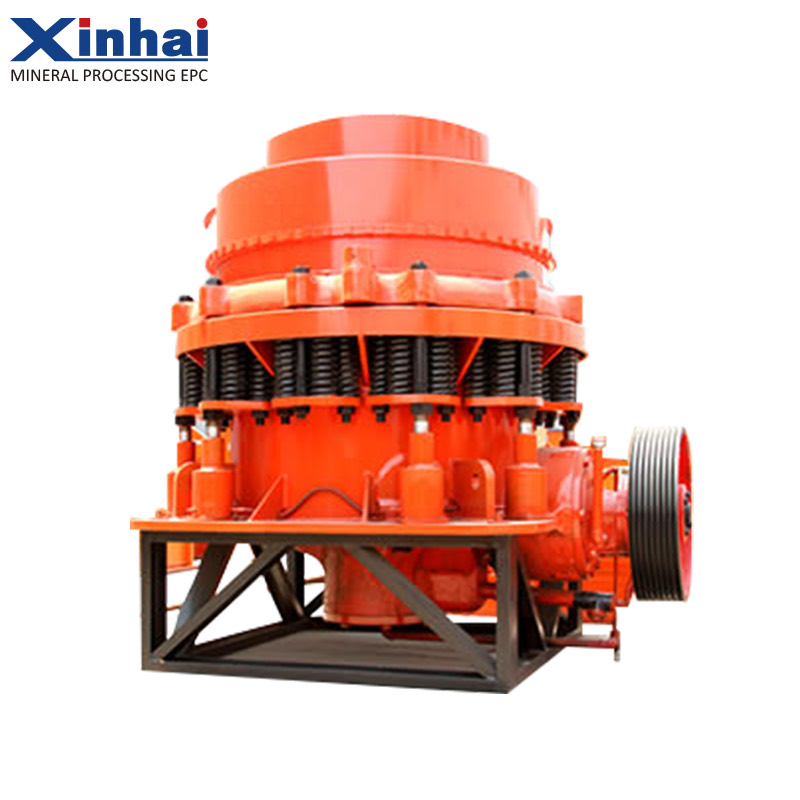
Jaw crushers are primary machines for coarse, blocky feed, using compression between two plates. Cone crushers are secondary or tertiary machines that crush in an annular gap with a gyrating mantle, producing finer, better-shaped product. Use a jaw first, then one or more cones behind screens to build an efficient crushing circuit.
If you’re sizing a crushing circuit, the first split isn’t jaw vs cone as competitors. It’s stage duty. A jaw crusher is a primary machine. A cone crusher is a secondary or tertiary machine. You rarely choose one over the other; you place both in sequence. This guide covers the crushing principle difference, reduction ratios, why three-stage circuits exist, feed control basics, and how screens decide closed or open circuit.
Crushing Principles: Two Different Compression Actions
A jaw crusher compresses rock between a fixed plate and a moving plate. The moving plate pivots at the top and swings at the bottom—single toggle motion. Feed enters the V-shaped chamber; the stroke squeezes it against the fixed plate, then releases so material falls lower. It’s a batch, not continuous, choke at the bottom exit. A cone crusher also uses compression but in a different geometry. A gyrating mantle eccentrically rotates inside a stationary concave bowl. The rock is crushed in the annular gap as the mantle swings toward and away from the concave, continuously nipping material as it travels down. That’s why cone product is more cubical and finer when properly fed.
Why Jaw Crushers Lead the Circuit
Run-of-mine feed is blocky, often up to 1 m across. No cone crusher can accept that top size economically. A jaw crusher’s large feed opening and aggressive stroke handle it. You don’t want a cone as primary because a cone needs a controlled, smaller top size to protect the mantle and ensure interparticle crushing. A jaw’s reduction ratio—typically 4:1 to 6:1, according to McLanahan’s jaw crusher technical page—turns a 600 mm boulder into roughly 100–150 mm product. That’s coarse enough for the next stage but manageable. For large plants, Xinhai supplies PE jaw crushers for this duty; see the PE jaw crusher page.
Why Cone Crushers Own Secondary and Tertiary Duty
A cone crusher is a compression crusher that operates best when it’s choke fed—a full crushing chamber with material above the mantle. In secondary crushing, it accepts the jaw’s product, typically 100–200 mm, and reduces it to 20–50 mm at a reduction ratio of 4:1 to 6:1, or up to 8:1 in closed circuit, according to McLanahan’s cone crusher technical page. The annular gap crushes in layers, not just at the nip point, so it produces less slabby product than a jaw. For finer tertiary work, a short-head cone (or spring cone) takes 20–50 mm feed and yields 5–15 mm, often ahead of a ball mill. Xinhai’s spring cone crushers fit this role; product page here.
Reduction Ratios and Why Three Stages Exist
Reduction ratio is feed top size divided by product top size. A single crushing stage can’t economically take 1 m run-of-mine to 10 mm mill feed. You’d need a ratio of 100:1. No crusher does that. Each stage typically handles 4:1 to 8:1, so three stages—primary, secondary, tertiary—make sense. For example, 600 mm feed to jaw at 5:1 gives 120 mm. That feeds a secondary cone at 5:1 to 25 mm. A tertiary cone at 4:1 to 6 mm. The math is linear; the benefit is lower energy and liner wear per tonne. A three-stage circuit also lets you insert screens between stages to scalp fines, reducing unnecessary crushing.
Feed Control: Choke Feeding and Uneven Liner Wear
Choke feeding means keeping the crushing chamber full at all times. A jaw crusher tolerates intermittent feed better because its stroke still grabs rock. A cone crusher doesn’t. If you starve a cone—feed it with gaps—the mantle hammers the liner in the same spots, causing uneven wear, ring bounce, and poor product shape. You’ll also get lower throughput because the machine isn’t full. To choke feed a cone, place a surge bin or feeder above it that meters rock continuously. The feed must be well distributed around the chamber. Xinhai’s electromagnetic vibrating feeder works for this; see feeder page. Proper feed control is step one in liner life and product consistency.
Open Circuit vs Closed Circuit: Screens Decide
Open circuit means material passes through the crusher once and goes on. Closed circuit means the crusher’s product goes to a screen; oversize returns to the same crusher. For secondary crushing, open circuit is common when the downstream stage can handle some oversize. For tertiary and quaternary crushing, closed circuit is standard because it locks in a target top size. You can’t get a consistent 12 mm product from an open circuit unless you use an enormous reduction ratio. Closed circuit with a vibrating screen gives you control: screen undersize goes to milling, oversize returns to the cone. Xinhai’s circular vibrating screens handle this duty; see screening page. The same principle applies to jaw circuits when a grizzly scalps fines before the jaw.
Sizing the Circuit by Target Product
Your target product size determines the number of stages. If you’re feeding a ball mill, you want 80% passing 10–15 mm, so you need at least three crushing stages. If you’re producing aggregate, a two-stage circuit may be enough because 20–40 mm product is acceptable. If you need sand or fine feed for HPGR, you may add a quaternary cone or vertical shaft impactor. The right question isn’t “jaw or cone?” It’s “how many size reductions, and where do I put screens?” Start with the feed top size, choose a primary jaw, then add secondary and tertiary cones until you hit the target. Check the crushing equipment category for all Xinhai crushing options.
Summary: Jaw Then Cone, Never One Alone
Unless your plant feed is already small and uniform, you won’t run a cone without a jaw ahead of it. The jaw handles the brutal, blocky, variable run-of-mine feed. The cone cleans up after it, producing finer, more cubical product. Three stages are common because each machine is limited to a 4:1 to 8:1 reduction. Choke feed the cone, close the circuit with screens, and let target product size drive stage count. For specific machine dimensions and throughput, contact Xinhai or review the PE jaw crusher and spring cone crusher pages.
Test Work Before Final Crusher Selection
Before you lock in a crusher size, run test work on a representative sample. Hardness, abrasiveness, moisture and clay content all affect chamber selection, liner life and required reduction stages. A Bond work index defines the energy needed to grind a ton of ore from theoretically infinite feed to 80% passing 100 µm; it is a standard measure of ore grindability, not a crusher setting. Without that data, you risk specifying a cone chamber that wears too fast or a jaw that cannot handle sticky feed. Xinhai reports about 200 beneficiation test programmes per year across more than 70 ore types, which means the flowsheet can be confirmed against real rock rather than a guess. The test result also tells you whether to expect slabby product from the jaw or high fines from the cone.
Liner Changeout and Wear Monitoring
Liner replacement is a scheduled task, not a surprise repair. Liner life is the operating hours a set of wear parts can run before product top size drifts outside the closed-side setting. Start by recording running hours for each liner set. Step one: inspect the jaw die or cone mantle for uneven wear after the first shift. Step two: measure the remaining thickness at the discharge end and in the upper crushing zone. Step three: compare product gradation from the screen against the target; a shift in oversize share often signals worn liners. Step four: schedule a changeout before throughput drops unacceptably. Xinhai reports more than 200 patents in large mining equipment, including crusher liners and chamber profiles, so liner choice can be matched to ore abrasiveness. Keeping a written log turns liner life into a predictable interval.
Frequently Asked Questions
What is the main difference between a jaw crusher and a cone crusher?
A jaw crusher compresses rock between a fixed and a moving plate in a V-shaped chamber, ideal for blocky primary feed. A cone crusher compresses rock in an annular gap between a gyrating mantle and a stationary concave, producing finer, more cubical product for secondary or tertiary duty.
Can a cone crusher be used as a primary crusher?
Rarely. Cone crushers need a controlled, smaller top size and choke feed; run-of-mine rock is too large and variable. A jaw crusher is the standard primary machine.
What is choke feeding and why does it matter?
Choke feeding keeps the crushing chamber full. It prevents uneven liner wear, improves product shape, and boosts throughput, especially for cone crushers.
How do I decide between an open and closed crushing circuit?
Use open circuit when downstream processing can tolerate oversize, and closed circuit with screens when you need a consistent top size for milling or final product.