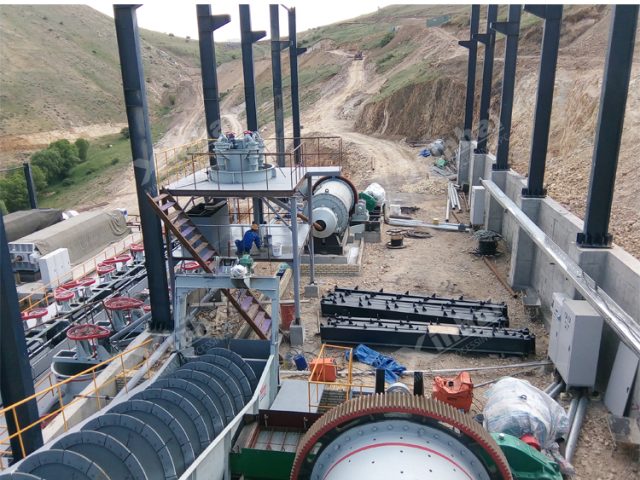
Field notes for a mine owner comparing ball mill quotes.

Say a mine owner asks: what should a ball mill price actually cover? That question, not mine cost estimates, is what most quotes fail to answer. You’ll get a number, but not the assumptions behind it. And the assumptions are what separate a fair price from a trap.
What Actually Drives Ball Mill Cost
The single biggest driver is the shell: its diameter and length set the effective grinding volume. Bigger shell means more steel plate, more machining, heavier castings and a bigger foundation. The shell diameter sets the internal volume and the torque required. Length, combined with diameter, sets the aspect ratio and residence time. A long mill gives longer retention, which changes the product size distribution. The quote should list both dimensions and the effective volume inside new liners.
Motor power scales roughly with volume and speed, so it climbs too. Drive type matters next. A low-speed synchronous motor with an air clutch costs different money from a wound rotor induction motor with a reducer. The quote should separate motor, drive and control system line items.
Liners and discharge design are not minor details. A grate discharge mill needs pulp lifters, grates and internal screens. An overflow mill has fewer wet-end wear parts but may need a different trunnion arrangement. Rubber liners weigh less than steel, install faster, and suit fine grinding or corrosive slurry. Steel liners survive heavy impact better. Each choice moves the capital and maintenance line items.
Then there are running costs. Power draw is the daily cost. Grinding media consumption is often the largest consumable on site. You’ll pay for that for years, long after the purchase price is forgotten. Always ask for the supplier’s assumed media consumption and liner wear intervals. If they won’t put those in writing, you’re buying a box, not a mill.
Lubrication scopes change the price too. A simple ring lubrication system is cheaper than a forced oil lubrication skid with pressure switches and temperature trips. But the skid may save a bearing down the line. Motor controls, variable speed drives, inching drives and condition monitoring all add cost. You decide whether the plant needs them at commissioning or can add them later.
Foundation loads are another hidden line item. A heavy mill on a soft site may need a deep foundation and dynamic analysis. That cost often lands in the civils scope, not the equipment price. The supplier should provide the total mass, dynamic load coefficients and centre of gravity.
Installation scope is the same story. A mill delivered as loose components costs less to ship but more to assemble on site. A mill delivered in large pre-assembled modules costs more at the factory but can cut site welding and alignment time. You trade one scope for another.
Ball Mill Types and Where They Fit
Wet grid mills discharge through a grate, hold a lower pulp level, and handle coarse feed well. They suit primary grinding ahead of a classifier. Wet overflow mills are simpler, with no grate assembly, and produce a finer product at a higher pulp density. Dry mills fit arid sites or flowsheets that need dry product downstream.
Type changes the quote for the same specification because grate mills carry more internal wear parts. Dry mills need dust collection and a different feed and discharge arrangement. You’ll see that in the itemised list.
| Type | Discharge | Typical circuit position | Main cost drivers beyond shell |
|---|---|---|---|
| Wet grid | Grate and pulp lifters | Primary grinding, closed circuit | Grate assembly, pulp lifters, heavier liner set |
| Wet overflow | Overflow trunnion | Secondary or fine grinding | Trunnion liners, no grate, lower internal parts count |
| Dry | Air swept or peripheral | Arctic or water scarce sites, some non-metallic flowsheets | Dust collection, air system, shaft seals |
For more on wet mill designs, see the wet ball mill range and the notes in ball mill grinding equipment.
Sizing a Ball Mill: Key Technical Parameters
You can’t compare mill prices properly until you’ve fixed the technical duty. Cylinder diameter and length set the effective volume. Motor power and maximum ball load follow from that. Feed size and product target particle size define the duty. P80 is the size 80 per cent of the mass passes: state it for both feed and product.
Two testwork results drive the calculation. The Bond work index, measured in kilowatt hours per tonne, tells you how much energy the ore resists. Liberation size, from mineralogical analysis, tells you how fine you need to grind to unlock the target mineral. If a supplier quotes without asking for these, you’re not getting a designed mill, you’re getting a catalogue guess.
Say you’ve got a hard ore with a high Bond work index. You’ll need more installed power and a bigger media charge for the same throughput. That changes motor, drive and liner selection. The same shell can be quoted at very different prices if the duty is specified differently. Capacity is not a single number. It depends on grindability, target product size and circuit configuration. The same mill can process considerably more of a soft ore than a hard one. So never accept a quote that promises a throughput without your ore test data.
How to Compare Ball Mill Quotations Fairly
Request the same specification fields from every supplier: diameter, effective length, motor rating, drive type, bearing type, liner material and thickness, rotation direction, foundation loads. If one quote omits the drive and another includes it, you are comparing apples and oranges. Ask for a line item list, not a lump sum.
Check the bearing design. A hydrodynamic trunnion bearing is different from a rolling element bearing. Rolling element designs may claim lower maintenance; verify that against your ore and duty. The supplier’s quote should state the design and the alignment tolerances.
New versus used: a used mill can look cheap but carries unknown remaining life in the shell, trunnions, girth gear and liners. Inspection and rebuild costs often close the gap. If you buy used, include a complete internal inspection, ultrasonic thickness testing and a gear contact pattern check in the contract.
Spares and warranty terms are part of the price. Ask what the standard spare set includes: liners, trunnion seals, filter elements, instrumentation. A quote that excludes spares is not cheaper, it just hides the cash you’ll spend in the first year.
A fair comparison strips installation scope out of the equipment price. Foundations, craneage, piping, electrical and instrumentation are separate lines. You want to see them separated so you can evaluate each scope honestly. The mill selection guide walks through this.
What a Manufacturer’s Capability Tells You About Price
A supplier that owns its factory and machines the shell itself isn’t paying a middleman. That shows up in how the quote is built. Whether it makes large mills matters too. If a workshop only rolls small shells, it can’t quote a φ7 m mill honestly; it would sub-contract and add margin.
Founded in 1997, Shandong Xinhai Mining Group Co., Ltd. offers EPC+M+O mineral processing services. Xinhai reports more than 600 mine EPC+M+O projects, according to the company’s published figures. Those projects span the plant design process, from testwork to operation, which means the equipment is specified inside a full flowsheet, not as a standalone box.
Demand for grinding capacity is real. U.S. crushed stone production alone was about 1.5 billion tons in 2025 (Mineral Commodity Summaries 2026). Construction sand and gravel added another 870 million tons the same year (USGS sand and gravel summary). Not all of that goes through a ball mill, but it shows the scale of mineral processing infrastructure where grinding is a bottleneck.
Ball Mill Buyer’s Checklist
Use this list when you ask for a quotation. Make every supplier fill in every field.
- Ore type, feed size and target product P80.
- Throughput in tonnes per hour on a dry basis.
- Bond work index and liberation size from your testwork.
- Mill diameter and effective length, inside new liners.
- Motor power, drive type, bearing type and lubrication system.
- Liner material, thickness and expected wear life.
- Grinding media specification, charge weight and predicted consumption.
- Delivery scope, installation supervision, spares and warranty terms.
If a supplier won’t complete the list, they’re not serious about a fit-for-purpose mill. Walk away.
Frequently Asked Questions
What is the price of a small ball mill?
There is no single price. A small mill for a laboratory is built to different tolerances than a small production mill. Ask the supplier to itemise the shell, motor, drive, liners, bearings and controls. Only then can you see what the number covers.
How much does a grinding mill cost?
The price moves with shell size, installed power, drive type, liner metallurgy and the engineering scope. A quote that says “turnkey” includes foundations, piping, electrical and commissioning; a bare equipment quote doesn’t. Compare line items, not headlines.
What is a ball mill used for?
A ball mill grinds ore to a fine enough size that the target mineral can be separated by flotation, leaching, gravity or magnetic separation. It’s a wet or dry tumbling mill charged with steel balls. The product size is controlled by residence time, media size and mill speed.
Where can I find ball mills for sale?
Start with manufacturers who own their fabricating shops and can quote a true factory price. Ask for references and an itemised specification. You can review the wet ball mill product page or contact the engineering team for a duty-based quotation.
Frequently Asked Questions
What is the price of a small ball mill?
There is no single price. A small mill for a laboratory is built to different tolerances than a small production mill. Ask the supplier to itemise the shell, motor, drive, liners, bearings and controls. Only then can you see what the number covers.
How much does a grinding mill cost?
The price moves with shell size, installed power, drive type, liner metallurgy and the engineering scope. A quote that says "turnkey" includes foundations, piping, electrical and commissioning; a bare equipment quote doesn't. Compare line items, not headlines.
What is a ball mill used for?
A ball mill grinds ore to a fine enough size that the target mineral can be separated by flotation, leaching, gravity or magnetic separation. It's a wet or dry tumbling mill charged with steel balls. The product size is controlled by residence time, media size and mill speed.
Where can I find ball mills for sale?
Start with manufacturers who own their fabricating shops and can quote a true factory price. Ask for references and an itemised specification. You can review the wet ball mill product page or contact the engineering team for a duty-based quotation.