Slurry pump selection isn't just about hydraulic duty. You need flow rate, total head, solids concentration, and particle size distribution to estimate wear. Then match the wet-end material—rubber for fine abrasive slurries, high-chrome alloy for coarse or sharp particles—and compare vendors on cost per tonne pumped.
Slurry pump selection is not a hydraulic sizing exercise. It’s a wear-life calculation. Every mineral processing plant moves slurries—mixtures of solids and liquid—through the circuit. If you treat a slurry pump like a clear-water pump, you’ll replace wet-end parts far too often. The slurry pump you choose must be matched to the ore, not just to the pipe.
You don’t size a slurry pump the way you size a clear-water pump. Clear water only asks about flow and head. A slurry brings three more variables: solids concentration, particle size distribution, and particle hardness. Those variables control how fast the pump’s wet end wears. If you ignore them, you’ll replace liners and impellers constantly, even when the hydraulic duty is correct. That’s why slurry pump selection starts with the ore, not just the duty point.
What Makes Slurry Different from Clear Water
Clear water is a single-phase fluid. Slurry is a two-phase mixture. The solids in a slurry don’t simply follow the water; they collide with pump surfaces, and those collisions remove material. Wear rate depends on particle sharpness, size, concentration, and the relative velocity between solid and surface. A pump that handles clean water for years can lose a volute liner in weeks on the same flow if the slurry contains hard, angular particles. The U.S. Geological Survey’s Mineral Commodity Summaries lists hardness and abrasiveness data for common minerals; quartz and garnet, for instance, are among the most destructive in mill circuits. The rule is simple: if the particles are harder than the wet-end material, they will cut it. That’s the core difference you must design around.
Slurry also behaves differently in the pump itself. The presence of solids increases effective viscosity, shifts the pump’s performance curve, and can cause severe localised wear at the cutwater and impeller tips. You need a pump built for abrasion, not just a standard water pump with a thicker casing. The Hydraulic Institute’s slurry pump standards describe how duty parameters should be reported to avoid ambiguous quotes, and they stress the importance of defining solids properties up front.
The Four Selection Inputs a Buyer Must Supply
When you ask for a slurry pump quote, send four numbers. First, flow rate—usually in cubic metres per hour (m³/h). Second, total dynamic head—the pressure the pump must overcome, in metres. Third, solids concentration by weight or volume—weight percent is more common in mining. Fourth, particle size distribution (PSD) and specific gravity of the solids. PSD tells you the percentage of particles above each size threshold. Specific gravity is the ratio of a material’s density to that of water. Without PSD, no supplier can estimate wear. Without flow and head, no supplier can select a pump that will operate near its best efficiency point. Those two numbers are the minimum floor; the other two determine wet-end life.
Most buyers send flow, head, and maybe solids %. They forget PSD. That omission kills the quote. A pump vendor cannot recommend rubber or metal without knowing whether the d80 is 300 µm or 80 µm. If you don’t have a PSD, say so. A competent supplier will ask for a sample or recommend a standard sieve analysis before quoting wear life.
Wet-End Materials: High-Chrome Alloy vs Rubber Lining
Wet-end material choice is a wear-rate decision, not a price decision. High-chrome alloy (white iron) performs best when particles are large, sharp, or coarse—think crushed ore, mill discharge with oversize, or coarse tailings. The hard metal resists cutting wear from angular particles, but it’s brittle and can crack under heavy impact. Rubber lining handles fine, rounded, or soft abrasives well—think fine sands, pulps, and chemically aggressive slurries. Rubber absorbs impact and flexes, so it resists erosion by fine particles bouncing off surfaces. But rubber fails quickly if the slurry contains coarse sharp particles, because cutting wear tears it. The exact cutoff depends on particle shape and pump speed, so the rule of thumb is: rubber for fine abrasive, high-chrome for coarse or sharp. Don’t specify a material until you’ve seen the PSD.
There’s a middle ground. Some pumps use a high-chrome alloy impeller with a rubber volute, or vice versa. The choice should follow the expected wear pattern. If the slurry has a wide PSD with both fine and coarse fractions, ask the vendor for a wear map. A good supplier will base the material selection on impeller tip speed and particle impact angle, not on a generic catalogue.
Why Running Far Off the Best Efficiency Point Destroys Wear Parts
Every centrifugal slurry pump has a best efficiency point (BEP)—the flow rate at which the pump operates with maximum efficiency and minimal hydraulic thrust. When you run a pump far left or right of BEP, internal recirculation increases. Flow separates from the impeller vanes, creating low-pressure zones where particles are flung against the casing at high velocity. The resulting wear is localised and rapid. A pump that spends most of its life far from BEP can wear out a volute liner several times faster than the same pump at BEP, even if the head and solids loading are identical. The Hydraulic Institute’s slurry pump standards explain how to map a system curve to the pump curve so the duty point sits near BEP. The point is to avoid buying a pump that is hydraulically “big enough” but operates in a destructive zone. Look at the entire system curve, not just a single point.
Many plants select a pump for the maximum head, then run it at half flow because the piping changed. That’s a classic mistake. You’ll see rapid wear on the suction liner and impeller shroud. If you can’t keep the pump near BEP, consider a variable-speed drive or a different impeller trim. The extra cost is small compared with repeated wet-end rebuilds.
Compare Quotes on Cost per Tonne Pumped, Not Sticker Price
Two pumps can have the same purchase price but very different operating costs. The difference is wear-part replacement interval. Suppose Pump A costs 10% less upfront but needs impeller and liner replacement every three months. Pump B costs more but runs two years between wet-end rebuilds. If your ore throughput is constant, the total cost per tonne pumped = (annualised capital cost + energy cost + wear parts + maintenance labour) divided by tonnes moved per year. Wear parts dominate that equation in abrasive service. So ask each vendor for expected wear life in hours, or better, in tonnes of dry solids. Then compare on a levelised cost basis. Don’t accept a quote that omits wear life. A vendor who won’t state expected wear life under your PSD is telling you they don’t understand the application.
Energy also matters, but mostly as a tie-breaker. If two pumps have similar wear life and price, choose the one with higher efficiency at your duty point. In a slurry pump, a few percentage points of efficiency can save real money over a decade, but losing half the wet-end life will erase that saving in the first year. When you ask for quotes, request the pump curve with efficiency lines, not just a price.
What to Send When Asking for a Quote
Send a short, complete data package. Use this checklist:
- Flow rate, in m³/h, at the pump suction.
- Total dynamic head, in metres.
- Solids concentration, as weight percent.
- Particle size distribution, with d50 and d80 values.
- Specific gravity of the dry solids.
- pH and temperature of the slurry.
- Whether the solids are sharp or rounded, if known.
- Voltage, frequency, and motor enclosure preference.
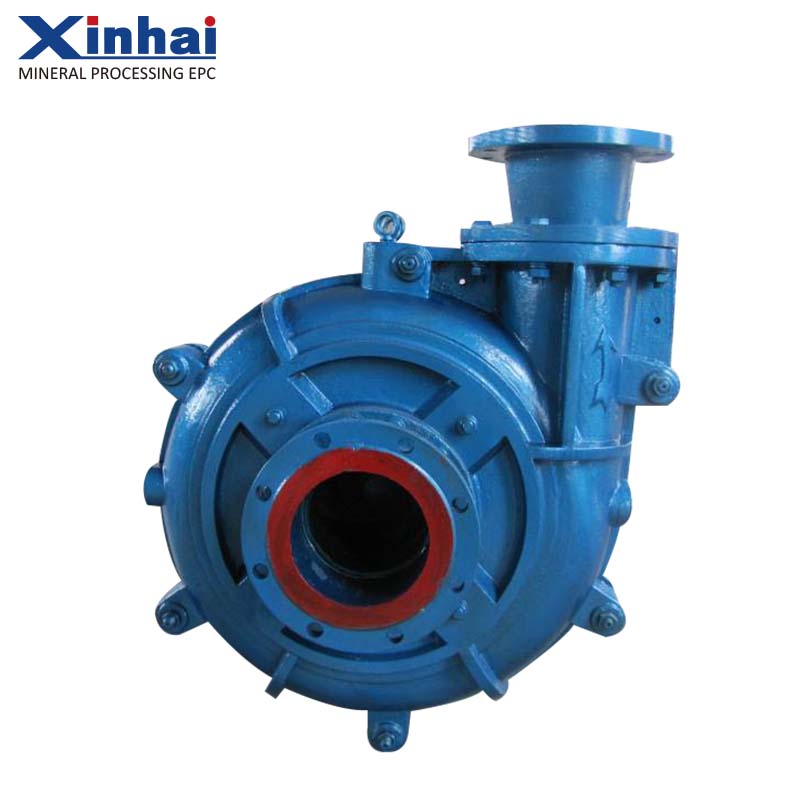
That’s eight fields. Most buyers send the first three and wonder why the pump fails early. The PSD and specific gravity are the two most often missing, and they are the two that most influence wear. If you don’t have a PSD, say so explicitly—a decent pump supplier will ask for a sample or guide you to a standard test. You can also browse the slurry pumps category and the centrifugal slurry pump product page to see how Xinhai organises its range.
A Practical Example Without Naming a Mine
Consider a plant running 800 t/d of milled gold ore. The slurry is 45% solids by weight, d50 = 75 µm, d80 = 150 µm. The ore contains quartz, so the particles are hard and angular. If you choose a rubber-lined pump, the fine quartz will erode the rubber quickly because quartz at 150 µm is still sharp enough to cut rubber at high velocity. A high-chrome alloy wet end will last longer on this coarse sharp feed. The duty point is 200 m³/h at 25 m head. That’s a moderate hydraulic duty, but the wear load is severe. So the pump frame may be standard, but the wet end must be heavy-duty. If the same plant changed to a tailings stream with d50 = 40 µm and rounded sand, a rubber lining would be the lower-cost option over the pump’s life. That’s how you make the decision: ore first, then material.
How Xinhai Approaches Slurry Pump Selection
We don’t quote a slurry pump until we see the duty and the ore. Xinhai’s slurry pump category covers a range of centrifugal slurry pumps, and the centrifugal slurry pump product page includes specifications you can use as a starting point. In our EPC projects, the pump selection is integrated with the process design, so the system curve and wear life are considered together. According to the company’s published figures, Xinhai reports more than 600 EPC+M+O projects, which means the company has seen a wide range of slurry duties. We use that experience to ask the right questions up front. No pump is selected on price alone.
Common Pitfalls
You’ll shorten pump life if you ignore solids concentration, if you buy on price, or if you run the pump at the wrong speed. Don’t assume a clear-water pump can be upgraded by adding a rubber liner. Don’t size by pipe diameter alone. Don’t accept a quote that doesn’t state expected wear life. And don’t operate a slurry pump dry—it relies on the liquid for cooling and lubrication. These are simple rules, but they prevent most premature failures. A slurry pump is a wear machine; treat it as such.
Quick Reference Checklist
Before you send a slurry pump enquiry, run through these ordered steps:
- Measure or calculate the flow range the pump must handle, not just a single point.
- Determine total dynamic head at the maximum and minimum system resistance.
- Obtain a representative sample of the slurry and have a PSD measured.
- Record specific gravity, solids concentration, pH, and temperature.
- Decide whether the application pushes you toward rubber or high-chrome based on particle size and shape.
- Request quotes that include wear-life estimates in tonnes of dry solids, not just hours.
- Compare vendors on total cost per tonne pumped over a five-year horizon.
That sequence keeps the focus on wear, which is the real operating cost. If a quote doesn’t address wear life, it’s not a complete quote.
Frequently Asked Questions
What is the most important factor in slurry pump selection?
Wear life is the most important factor. You must define flow rate, total head, solids concentration, and particle size distribution. The wet-end material should match the ore: rubber for fine abrasive slurries, high-chrome alloy for coarse or sharp particles.
When should I choose a rubber-lined slurry pump?
Rubber lining works best for fine, rounded, or soft particles, typically below a few millimetres in size. It's also good for chemically aggressive slurries because rubber resists corrosion better than metal.
What is the best efficiency point (BEP) and why does it matter?
The best efficiency point is the flow rate at which a centrifugal pump operates at maximum hydraulic efficiency. Running far from BEP increases internal recirculation and accelerates wear on liners and impellers.
How do I compare slurry pump quotes on total cost?
Ask each vendor for expected wear life in hours or tonnes of dry solids. Then calculate annualised cost per tonne pumped, including capital, energy, and wear parts. Never buy on price alone.