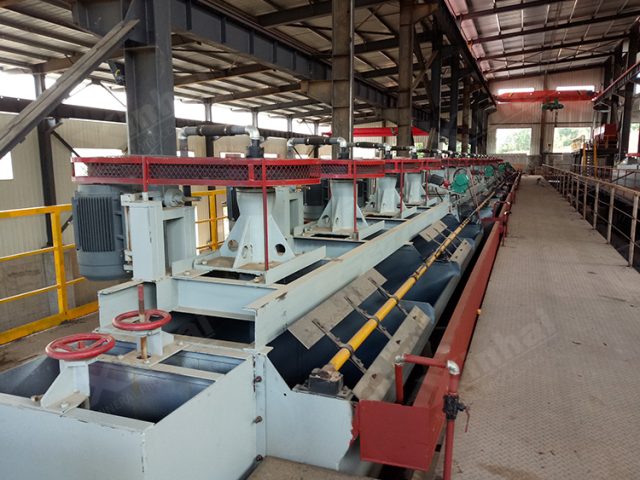
Field notes on how a stone crusher plant is laid out, from feed hopper to finished stockpile.

Say a mine owner asks how a stone crusher plant is laid out. You start at the feed hopper and you don’t stop until the final product piles are stable, dust is controlled, and the screens are not the bottleneck. A stone crusher plant is a linear process, but the layout isn’t a straight line. It’s a sequence of stations sized so that no single machine starves the next one.
How a stone crusher plant is laid out
Feeding, primary, secondary, tertiary, screening, stockpiling, conveying: those are the building blocks. Raw stone enters at the feed hopper, a scalping screen or grizzly removes fines, the primary crusher takes the coarse rock, and the rest follows. Each station needs enough surge capacity to absorb the normal stops and starts of upstream equipment. If the primary jaw trips, the secondary cone should run on for a few minutes from a surge pile. That’s not a luxury. It’s layout 101.
A heavy-duty apron feeder or vibrating grizzly feeder starts the flow. Every station must be sized for the target tonnes per hour, not for an average day. Peak feed to a crusher is rarely the average. You design for the maximum sustained feed rate, with a bit of headroom. A common mistake is to give the crusher a perfect feed but no room to maintain it. You’ll spend more time with a crane in the wrong position than with a worn liner. So walk the process as you design it. Ask where the wear parts go, where the trucks tip, where the loader works. See the mineral processing plant design guide for the wider flowsheet context.
Primary crushing: jaw or gyratory
The initial reduction is usually done by a jaw, impactor, or gyratory crusher (EPA AP-42, 11.19.2). For hard, abrasive stone, a jaw crusher is the standard choice. It’s forgiving, simple to maintain, and handles blocky feed well. A gyratory is another option for very high capacity abrasive feed, but it’s taller and needs deeper foundations.
Grizzly bars or a heavy-duty vibrating scalper sit ahead of the primary. Their job is not just to bypass fines. They protect the jaw from packed, sticky material that can wedge the crushing chamber. The closed-side setting on the primary controls its product top size. The crusher product from this stage is normally 7.5 to 30 cm in diameter (EPA AP-42). That’s coarse enough for the next crusher.
Secondary and tertiary crushing stages
Cone crushers are commonly used for secondary crushing, typically reducing material to about 2.5 to 10 cm (EPA AP-42). A cone crusher suits hard rock because it crushes rock against rock in a compressed layer. For soft or medium rock, an impact crusher can replace the cone in secondary duty, but it’s more sensitive to moisture and steel.
A tertiary stage, often another cone or a vertical shaft impactor, tightens the product shape and produces the finer fractions. A sand making machinery option covers the finer end. You need a tertiary stage when the product specification demands a high percentage of cubical particles or when the secondary product is still too coarse for the market. Closed-circuit recirculation of oversize is standard here. The screen sends plus-size material back to the tertiary feed.
How many stages? That depends on the total reduction ratio, rock hardness, and the target product. More on that below.
Screening, stockpiling and conveying
Vibrating screens separate the crushed stone by size. They also protect downstream equipment from oversize. A screen deck that is too small becomes the bottleneck, and every tonne of recirculating load has to go back through the crusher. So size screens for peak feed, not average feed. The number of screen decks depends on how many products you need. Two decks give three products. Three decks give four. Wet screening may be needed if the feed is dirty. Conveyors and stackers then move sized products to individual stockpiles. Don’t let a single transfer point hold up the whole plant. A blocked chute at 2 a.m. is a production stoppage.
Dust and spillage control at transfer points is an operating factor, not a cosmetic one. Spray bars, skirts, and proper belt speeds reduce carryback and airborne fines. You’ll also want enough live storage under each finished product to fill a truck without stopping the screen. When you sell to paving customers, ask for a specification such as ASTM D692/D692M. That sets the aggregate quality and size limits.
Stationary vs modular crushing plants
A stationary plant sits on concrete foundations and is designed for a long life, often decades, in the same quarry. You’ll pour big bases, set the crushers, and run them hard. A modular plant arrives as pre-assembled modules or skids that bolt together. It suits a short-term contract, a remote site, or a fast-track schedule. The trade-off is that modular plants often have less surge capacity and may need more frequent relocation.
| Factor | Stationary plant | Modular plant |
|---|---|---|
| Foundations and civil works | Large concrete bases, longer installation | Smaller pads or steel skids, faster setup |
| Relocation | Not practical | Designed to move |
| Surge capacity | Large bins and stockpiles | Limited, needs careful scheduling |
| Capital cost | Higher civil and installation cost | Often lower upfront, but watch logistics |
| Best fit | Long-term, high-capacity quarry | Contract crushing, remote or temporary sites |
That table isn’t a verdict. It’s a set of questions to ask.
How throughput and product spec set the number of stages
Feed size and target product size determine the reduction ratio. That ratio, more than anything else, sets the number of stages. Say you’re feeding 600 mm rock and you need a 20 mm road base product. You can’t do that in one machine. You’ll need primary, secondary, and probably a tertiary stage. If your product is 40 mm and your feed is 400 mm, two stages might do.
Rock hardness and abrasiveness also matter. Hard, abrasive rock favours jaw and cone crushers with slower wear. Softer, less abrasive feed can handle impact crushers, which give a better shape in fewer stages. But every extra stage adds screens, conveyors, and recirculating load. So the question is not just whether you can reach the size. It’s whether you can do it economically without creating bottlenecks.
A plant with three stages and a single screen deck may produce less than a two-stage plant with a well-designed screen and recirculation loop. That’s why layout and process calculation go together. The reduction ratio is feed top size divided by product top size. A stage reduction of 4:1 to 6:1 is common, but the real number comes from your own testwork.
What to ask before you buy a stone crusher plant
Before you sign anything, ask for testwork and process calculation. A supplier should crush your rock, characterise its hardness and abrasiveness, and size the crushers from that data. Not from a catalogue. Ask to see the mass balance for each stage. Ask what happens when the feed contains 15% clay or when the crusher liners are 80% worn.
Wear parts, maintenance access, and spare parts supply decide your operating cost. You’ll need liner change-out procedures, wear part lead times, and local stock levels. Ask the supplier whether it offers engineering, procurement, and commissioning, or just equipment sales. A complete EPC supplier will take responsibility for the interface between electrical, mechanical, and civil work. That interface is where projects go wrong.
Ask what performance test will be run after commissioning, what the acceptance criteria are, and who pays if they aren’t met. Don’t accept a verbal promise. Xinhai reports that its mining research institute operates a CNAS-accredited laboratory covering 70+ ore types, about 5,000 element analyses per month, and Bond work index testing. Xinhai’s mine design institute holds a Class B metallurgical industry design qualification and designs to JORC, NI 43-101, VALMIN, GB, Eurocodes, US, and Australian standards. A transparent supplier will also give you its engineering office address. Xinhai’s headquarters address is No. 188 Xinhai Street, Fushan High-tech Industrial Development District, Yantai, Shandong, China.
If a supplier won’t show you the process calculations or won’t put the commissioning scope in writing, keep looking.
Frequently Asked Questions
What does a crusher plant do?
A crusher plant takes quarried rock, reduces it through a series of crushers and screens, and produces sized aggregate for construction, road base, concrete and asphalt. The exact products depend on the screen deck openings and the number of crushing stages.
How do I set up a stone crusher plant?
Start with a measured feed size and a clear product specification. Do crushing testwork, calculate the reduction ratio, and size the primary, secondary and tertiary stages from that data. Lay out the feed hopper, screens, conveyors and stockpiles so no station starves the next. Then handle permits, civil works, installation, commissioning and operator training. A supplier that offers engineering, procurement and commissioning can take on the interfaces between those tasks.
What factors determine stone crusher plant cost?
The main factors are the number of crushing stages, the size and type of crushers, screen deck count, conveyor lengths, civil works, electrical and control systems, site access and freight to site. Higher capacity and harder rock push both equipment size and wear part consumption up. Modular plants often reduce upfront civil cost but add logistics and setup cost. You should ask any supplier for a breakdown built around your feed and product specification, not a catalogue price.
What is the difference between stationary and mobile stone crusher plants?
Stationary plants sit on concrete foundations and are built for long-term, high-capacity quarry use. Mobile plants are mounted on tracks or wheels, move between sites, and set up quickly. Mobile plants usually have less surge capacity than a stationary plant with large bins and stockpiles. Stationary gives you more flexibility in layout and expansion, while mobile suits short contracts and remote or changing faces.