
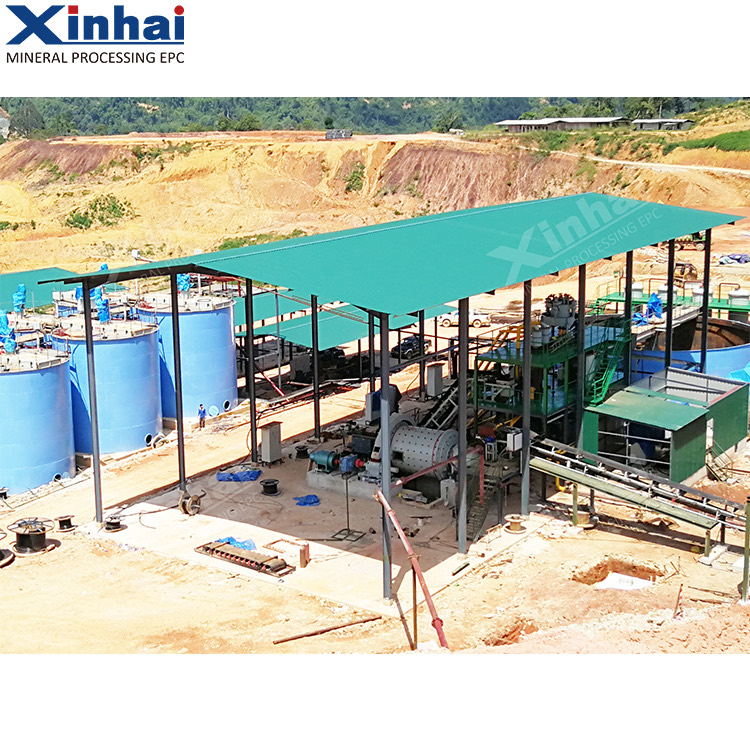
Background: 1.2 g/t leaves you nowhere to hide
Guinea has plenty of gold deposits that look unremarkable on a drill log. This was one of them. Feed into the plant runs at 1.2 g/t, and that single number drives the economics of everything downstream of it. At that grade you move a great deal of rock for a modest amount of metal. Every point of gold that leaves in the tailings is money you never see again, and at 3,000 t/d that loss repeats every shift, every day, for years. So here is the headline before the detail: on that 1.2 g/t feed, overall recovery has held at roughly 93%. That is the number this page is about.
Split design, supply and construction across separate contracts and the interfaces belong to nobody. Drawings from one company meet steel from a second and an installation crew from a third, and the seams between them are where a plant quietly loses tonnes. EPC+M+O puts all five stages under one signature instead.
That is the contract form used here: engineering, procurement, construction, management, operation. Turnkey delivery of the mine and the plant, then operation of both.
Scope: what a single contract actually covered
Five letters, five stages. On a job shaped like this one they break down as follows.
- E — Engineering. Ore testing, study work, and full-cycle design of the mine and the plant.
- P — Procurement. Manufacture and packaged supply of the equipment.
- C — Construction. Site construction, installation and commissioning.
- M — Management. Management of the mine construction itself.
- O — Operation. Running the operation once the plant is live: production, equipment, safety, environmental and human-resource management, plus materials, spares, technical support and expansion work.
Ask yourself who carries the risk when those five sit with five different suppliers. The designer blames the equipment. The equipment supplier blames the installation. The installer blames the drawings. The plant runs under nameplate the whole time, and the owner pays for all of it. A fuller description of how the model is put together sits on our mineral processing EPC page.
How the flowsheet gets decided: test work, not a catalogue
Test work first. Always test work first. A low-grade gold ore won’t tell you how it wants to be treated — you have to ask it, in a lab, before a single foundation goes in. How the gold occurs, how fine you need to grind, how it answers to gravity, to flotation, to leaching, how much reagent it drinks: those answers come off the bench and out of the pilot plant, and they are what fixes a circuit.
Xinhai runs a CNAS-accredited laboratory under ISO/IEC 17025 alongside an industrial-scale pilot base, and according to the company’s published figures completes roughly 200 mineral processing test programmes a year across 70+ ore types. The design institute behind the drawings spans 17 disciplines — geology, mining, mineral processing, civil, electrical, automation, tailings and general layout among them — so the flowsheet, the buildings and the power distribution get argued out in one room rather than by email between three companies.
None of that is a Xinhai peculiarity. Geoscience Australia’s public reference on gold makes the same point from the other end: much of the gold mined there cannot be seen in the rock at all, and the recovery route — gravity for coarse gold, cyanide leaching with adsorption onto activated carbon, extra treatment where the gold sits locked inside sulphides — follows from how the gold occurs rather than from how big the plant is. Their summary is here: Geoscience Australia, gold.
Want the reasoning behind the main gold routes in plain language? Start with our gold processing solution, then read gravity, flotation and leaching compared. Where an ore points toward carbon adsorption, the difference between the two common circuits is laid out in CIL versus CIP. None of those choices should be made before your ore has been tested. That is the whole point.
Where the interface risk actually gets removed
Interfaces are where projects bleed. The model is built to have fewer of them.
Equipment is manufactured in-house across three intelligent manufacturing bases totalling around 110,000 m², covering 1,000+ equipment models, with capacity for ball mills up to φ7 m, flotation cells to 320 m³, leaching tanks to φ20 m × 20 m and thickeners to φ100 m — enough to serve a single project up to 50,000 t/d. A 3,000 t/d gold plant sits well inside that envelope, which matters less for capacity than for lead time and accountability: when a mill is late, it is our problem and not a third party’s.
In China, the group’s engineering management company holds a Class-A qualification for general contracting of mine construction projects. That qualification is a Chinese licence and nothing else — it is not a construction permit in Guinea or anywhere outside China, and an overseas job still runs under the host country’s own permitting. Overseas the same construction management system is applied under ISO 9001, ISO 14001 and ISO 45001. You can see the wider service picture on our about page, or browse related equipment classes under gold extraction and mineral processing plants.
What the project record confirms
The verified result here is narrow, and we won’t dress it up. Feed grade into the plant is 1.2 g/t. Overall recovery has stabilised at roughly 93%. Those two figures are what our project brochures record for this contract, and they are the only performance numbers published for it.
Read the recovery figure as an operating number rather than a design promise. A number quoted on the day of handover means very little. The one worth quoting is the one that still holds after a plant has been running for a while under somebody’s daily management — and keeping it there is an operations job, which is exactly why the O sits in the same contract as the E.
What this means for your project
If your deposit is low grade and remote, the questions worth putting to a contractor aren’t about equipment brands. They are: who owns the recovery number after handover, who trains the operators, and who pays when the circuit underperforms. Under EPC+M+O the answer to all three is one party.
Your ore isn’t this ore, though. Grade, mineralogy, hardness and water supply will push your flowsheet somewhere else, and only test work will tell you where. See more delivered work on our project cases page, or send us your ore details and we’ll tell you what testing your project needs first.
Frequently Asked Questions
How is the delivery schedule set for a project like this, and can you commit to it?
Schedules get built backwards from the site, not from a template. Access roads, power, distance from port, rainfall patterns and the volume of civil work your site demands usually decide more than the equipment does. On EPC deliveries, engineering, manufacturing and construction are normally overlapped rather than run in series, and where the main equipment comes out of the contractor's own shops, third-party lead times stop being a hidden variable. A firm programme is issued once the design basis is fixed. We won't quote a duration before we have seen your ground conditions.
What does a 3,000 t/d gold plant cost to build?
There is no honest single figure, and be careful with anyone who offers one. Capex on a plant this size is driven by the flowsheet the ore demands, the amount of civil work the site needs, power and water infrastructure, tailings storage, and how much of the mining scope sits inside the contract. What we can do is give you a costed scope once test work and a study have defined the circuit. Send us the ore data and the site location and we will scope it properly.
Who runs the plant after commissioning — your people or ours?
Both, and the balance shifts over time. Under the O part of an EPC+M+O contract, the operating scope covers production, equipment, safety, environmental and human-resource management on site, and human-resource management is where operator capability gets built. A remote gold plant that depends permanently on expatriate operators is fragile and expensive, so the handover path matters. Which roles the owner's own people take over, and when, is written into the contract rather than left to goodwill at the end.
Our ore is lower grade than 1.2 g/t. Is it still worth processing?
Possibly, but grade alone will not answer it. How the gold occurs, how hard the rock is, how much reagent it consumes and what recovery the circuit can hold together decide whether a low-grade deposit pays. A slightly richer ore with awkward mineralogy can be a worse project than a leaner, cleaner one. Bench and pilot testing is where that question gets settled, and it is the first thing we would run on your samples.
More projects
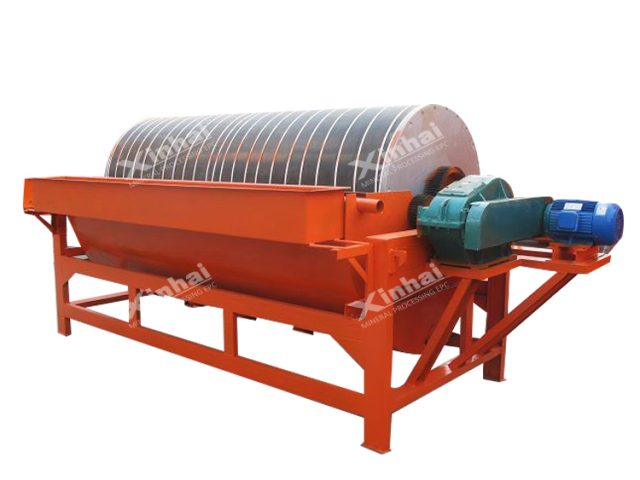
3,500 t/d Iron Ore Plant — Mongolia
Primary iron concentrate at ≥65% Fe with a yield of about 31%, plus a secondary concentrate…
Read case →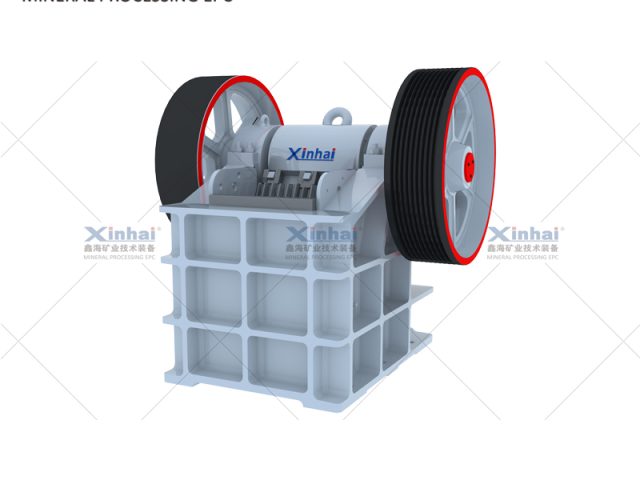
500,000 t/a Wollastonite Mining — Jiangxi, China
Standardised mining practice implemented across the operation, with ore dilution held strictly below 5%
Read case →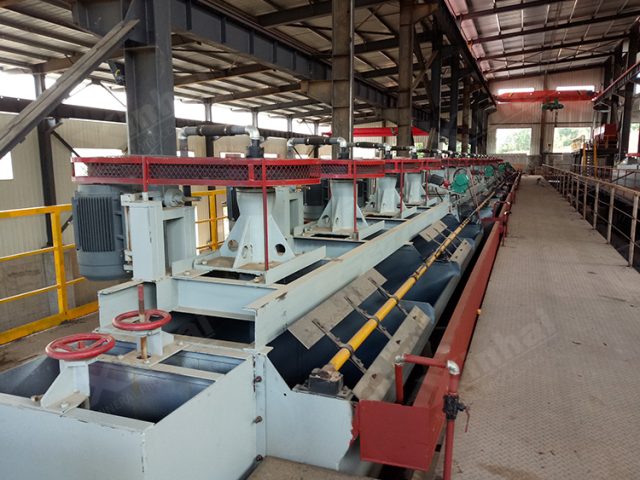
1,500 t/d Copper Plant Design — Pakistan
A design-only (E) engagement for a 1,500 t/d copper concentrator; Xinhai's recorded scope was engineering and…
Read case →