
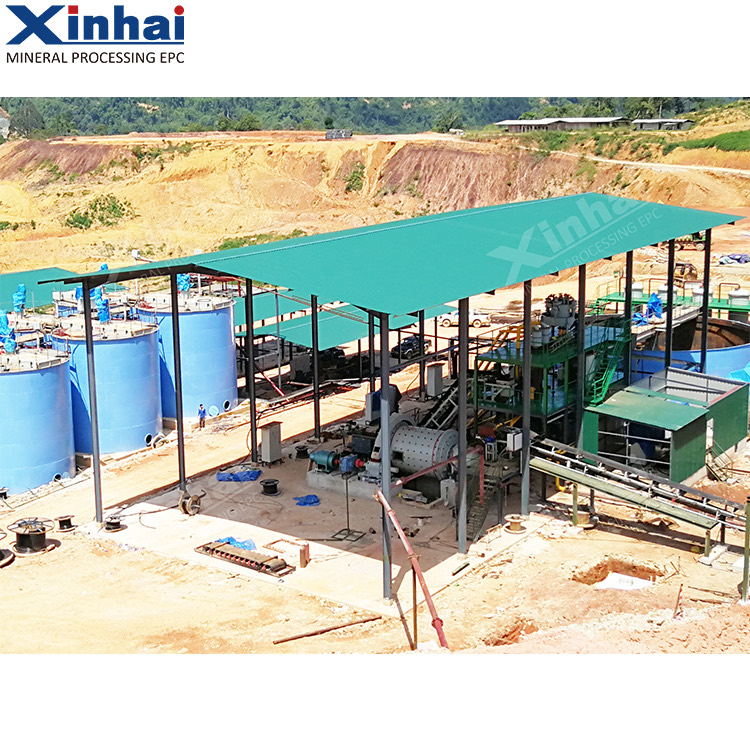
Typical process flow
- 1Crushing & screening
Staged crushing reduces run-of-mine ore to mill feed size, with vibrating screens closing the circuit; the product size target follows from the mill's economic feed size and the crushing work index of the ore.
- 2Grinding & classification
Wet ball milling in closed circuit with hydrocyclones liberates the gold at the liberation size for that ore; Xinhai machines ball mills up to 7 m in diameter in-house.
- 3Gravity recovery
Centrifugal concentrators and shaking tables capture coarse free gold early, lifting overall recovery and cutting reagent load.
- 4Flotation (refractory ore)
For sulfide-locked gold, flotation produces a gold-bearing sulfide concentrate for leaching or oxidative pretreatment.
- 5Cyanidation - CIL or CIP
Leaching in agitation tanks with activated carbon dissolves and adsorbs gold; CIL leaches and adsorbs simultaneously, CIP in sequence.
- 6Elution, electrowinning & dewatering
Loaded carbon is stripped, gold is electrowon and smelted to dore, while thickeners and filters recover water and manage tailings.
What the ore decides before anyone specifies equipment
Two questions settle much of a gold flowsheet before anyone specifies a single piece of steel: is the gold free-milling or refractory, and how coarse is it? Free-milling ore gives up gold to cyanide once it has been ground fine enough. Refractory ore does not. There the gold sits locked inside sulphide crystals, or the ore carries native carbon that pulls dissolved gold back out of solution, a behaviour called preg-robbing that is brutal on a leach. Treat that feed as if it were free-milling and much of your value leaves with the tailings, and it won’t come back once the tailings line is running.
Which of the two you are holding is a question for test work, and a gold processing plant is only as good as the programme it was designed from. Xinhai’s mineral research institute runs diagnostic leaching, bottle rolls, open- and closed-circuit tests and, where the flowsheet justifies it, continuous piloting at an industrial-scale pilot base; the analytical laboratory is CNAS-accredited under ISO/IEC 17025, and Xinhai reports roughly 200 ore-dressing test programmes a year across more than 70 ore types. The results are what the mills get sized from, what the leach residence time is fixed against, what the reagent dosing is set by, and, usually the expensive thing to discover late, whether a pretreatment stage is unavoidable at all.
None of that is a supplier quirk. The disclosure codes ask for the same evidence. Form 43-101F1 under Canada’s NI 43-101 requires a technical report to discuss “the basis for any assumptions or predictions regarding recovery estimates”, how representative the test samples were of the deposit as a whole, and any “processing factors or deleterious elements that could have a significant effect on potential economic extraction”. A qualified person signing that report and an EPC contractor drawing the plant are working from the same file.
The free-milling route: crush, grind, catch the coarse gold, then leach
Run-of-mine rock goes through staged crushing, jaw first and then cone crushing closed with circular vibrating screens, down to a size the mill can handle economically. Grinding follows in a wet ball mill closed with hydrocyclones. The target is the liberation size for that particular ore. Push finer than it and the extra power buys nothing while the slimes it creates slow thickening and filtration downstream; the coarse side of the error is worse, because gold still sealed inside sulphide or quartz never meets cyanide at all. Xinhai machines ball mills up to 7 m in diameter in its own shops, so mill selection isn’t boxed in by what happens to sit on a catalogue page.
Then comes the step buyers underestimate: take the coarse gold out before it ever meets cyanide. A gold centrifugal concentrator in the milling circuit, cleaned up on a shaking table, sends gravity-recoverable gold straight to a smeltable concentrate. Coarse particles dissolve slowly, so leaving them in the leach costs residence time, cyanide and carbon, and a share of that gold still reports to tails anyway. Alluvial and weathered near-surface material often puts a gold trommel screen ahead of the gravity stage; the jigs, spirals and tables sit in our gravity concentration equipment range. For a side-by-side view of the three main routes, read our guide to gravity, flotation and leaching.
What survives gravity goes to cyanidation in double-impeller leaching agitation tanks with activated carbon in the circuit. CIL leaches and adsorbs at the same time, and on preg-robbing or slow-leaching ore that simultaneity is the whole reason to choose it. CIP adsorbs after leaching, in its own train, and can be the cheaper build on clean, fast-leaching material. Our turnkey CIP gold processing plant package bundles tanks, interstage screens, carbon transfer and the reagent system; the trade-offs are set out in CIL vs CIP, and the same choice at lower tonnage is framed in our small-scale gold plant guide. Leach tanks up to 20 m in diameter by 20 m high are fabricated in-house, which keeps a long tank train off the import critical path.
Reagents and residence time drive the cost line
Five variables carry the bulk of the operating cost in a cyanide circuit: pulp density, protective alkalinity, free cyanide strength, carbon concentration and the number of tanks in the leach train. Published industry practice gives usable starting bands for the first three. Agitated cyanidation of oxide ore is conventionally run at around 50 percent solids with roughly 0.05 percent sodium cyanide over a four to twenty-four hour leach, while finer-ground sulphide feed is more often run nearer 40 percent solids at about 0.1 percent cyanide for anything from ten to seventy-two hours. Those are general engineering envelopes reported for the industry, not a Xinhai result, and a specific ore can sit well outside them.
Protective alkalinity is the variable with a hard floor. Lime holds the pulp in the alkaline range, conventionally pH 9.5 to 11 with about 10.5 treated as the optimum. Below that band cyanide is lost to hydrolysis, to reaction with carbon dioxide and to the formation of hydrogen cyanide gas, and that last loss is a safety failure before it is a metallurgical one. There is a ceiling as well, since strongly alkaline conditions slow the leach reaction itself. Lime consumption has to be designed against the acid-generating minerals in the feed, and a plant that meters lime on a fixed dose will drift out of the band the first time the ore changes; pH control has to close the loop.
Carbon concentration sets the adsorption driving force in each stage. Carrying more carbon pulls soluble losses to tails down, and it also raises attrition, screening duty and the size of the elution and regeneration plant, so the inventory gets set against a measured soluble loss rather than pushed as high as the circuit will physically take. Tank count behaves the same way. One large vessel acts as a single stirred reactor and short-circuits part of the feed; splitting the same volume across a train in series moves the circuit toward plug flow and tightens the residence-time distribution. Between those two expensive levers there is a plain rule. If the leach curve is still climbing at the end of the train, you’re short of time and the circuit needs volume or another stage; a curve that has already flattened while free cyanide is being eaten early by copper, reactive sulphides or other cyanicides points somewhere else entirely, because extra residence time changes nothing there and the fix is dosing strategy, staged addition or pretreatment. Reagent handling, cyanide destruction and site water management then get designed to the permitting regime of the host country, since one house standard applied everywhere is how a plant ends up out of compliance in the only jurisdiction that matters. Practical levers are covered in our note on reducing gold cyanidation cost.
Refractory ore needs a step before the leach
Sulphide-locked, arsenical and carbonaceous gold is a different project, and flotation usually comes first. Flotation cells pull a gold-bearing sulphide concentrate and shrink the mass that has to be treated intensively downstream; our packaged copper flotation plant, the same cell, blower, reagent-dosing and concentrate-handling configuration used on gold-bearing sulphides, covers that scope as a single supply. The concentrate is then oxidised by roasting, pressure oxidation or bio-oxidation, and the choice turns on sulphide mineralogy, arsenic content, energy cost and what the environmental permit will actually allow. Only after oxidation does cyanidation make sense. Carbonaceous feeds may also need a blanking reagent or a CIL configuration to hold off preg-robbing.
By the time an underestimated pretreatment requirement shows up in production, the tank train, the reagent plant and the tailings design have all been built around the wrong assumption. Correcting it means new capital inside an operating plant, and the ramp-up schedule doesn’t survive that intact.
Elution, electrowinning and closing the water loop
Loaded carbon moves to a gold elution and electrowinning system, where gold is stripped at elevated temperature and pressure, won onto cathodes, then smelted to doré. Stripped carbon passes through a regeneration kiln and returns to the adsorption circuit, and barren solution goes back to leach.
Downstream, deep cone thickeners and a filter press recover process water and dewater tailings for safe storage; thickeners up to 100 m in diameter are within Xinhai’s fabrication limits. In arid districts the water balance shapes the flowsheet as much as the metallurgy does, and it belongs on the table at the study stage, before the site layout is frozen and a raw-water allocation nobody has confirmed has quietly been assumed into the mass balance. Browse the full gold extraction equipment range to see how the units connect.
Delivering the gold processing plant under one contract
Under EPC+M+O one contractor carries a gold processing plant from ore testing through design, manufacturing, construction, commissioning and, if you want it, operations. The design institute covers 17 disciplines under one roof, from geology and mining through processing, tailings, electrical, automation and general layout, and works to the JORC, NI 43-101 and VALMIN reporting frameworks. Equipment is built in the group’s own plants under ISO 9001, ISO 14001 and ISO 45001 systems, with CE and CSA certification available for export markets, and single-project scale runs up to 50,000 t/d. According to the company’s published figures, Xinhai has served more than 2,500 mines and delivered over 600 mine EPC+M+O projects across more than 100 countries and regions.
Two gold references are worth opening. The 3,000 t/d gold plant in Guinea runs as a turnkey mining-and-processing operation on a 1.2 g/t feed, with overall recovery held at about 93%. The 500 t/d gold plant in Zimbabwe was delivered EPC plus operations, with the mining and processing flowsheet tailored to the deposit and the local crew trained to a standard procedure set. More sit in our project record, and other ore types are covered under solutions.
Where the gold is actually being mined
Some context on the market you are building into. The USGS Mineral Commodity Summaries 2026 put world gold mine production at an estimated 3,300 tons in 2025, against 3,280 tons in 2024, with China, Russia, Australia, Canada and the United States together accounting for 41% of estimated global output. The balance is spread across West Africa, Central Asia, South America and Southeast Asia. Those are the districts where grid instability, long spare-parts lead times and a crew that has to be trained from zero shape the design alongside the metallurgy. A flowsheet that works on paper in one country can be the wrong plant in another.
If you want a plant sized against your own deposit, send a representative sample and a target throughput, and talk to our process team.
Sources
- U.S. Geological Survey, Mineral Commodity Summaries 2026: Gold
- National Instrument 43-101, Form 43-101F1, Item 13: Mineral Processing and Metallurgical Testing (official B.C. consolidation)
- U.S. Environmental Protection Agency, Technical Report: Treatment of Cyanide Heap Leaches and Tailings (EPA530-R-94-037, September 1994)
Frequently Asked Questions
Is my gold ore free-milling or refractory?
The two behave differently under the same leach conditions, and diagnostic work separates them. Free-milling ore gives high cyanide recovery after grinding alone. Refractory ore falls short for one of three reasons: gold locked inside sulphide crystals, native carbon that adsorbs dissolved gold back out of solution, or arsenic-bearing minerals that both host the gold and consume reagent. Diagnostic leaching attacks the sample in stages so the responsible fraction can be identified; that result decides whether flotation, oxidative pretreatment or both belong in the flowsheet. Xinhai runs this work at bench scale and pilots where the flowsheet warrants it.
Should I choose CIL or CIP for my gold plant?
CIL leaches and adsorbs onto carbon at the same time, so plant carbon competes with the ore's own carbon for dissolved gold from the first tank onwards, and that is the behaviour preg-robbing or slow-leaching ore needs. CIP adsorbs after leaching in a separate train, which keeps carbon out of the leach tanks, simplifies interstage screening and can cut the build cost on clean, fast-leaching material. The deciding inputs are leach kinetics, whether preg-robbing carbon is present, and how much interstage screening duty the pulp will impose.
Why add gravity recovery if I am already cyanide leaching?
Because coarse gold dissolves slowly. Catching it in a centrifugal concentrator and on a shaking table before the leach shortens residence time and cuts cyanide and carbon consumption. Gold recovered that way also bypasses the leach entirely, so it carries no reagent cost, no carbon inventory and no elution duty. Its unit cost sits below leach recovery on the same ore.
What gold recovery can I expect?
We will not put a number on it before your ore has been tested. Recovery on a gold plant is driven by how the gold occurs (free, locked in sulphides, or sitting alongside preg-robbing carbon) plus grind size, reagent regime and residence time, and two deposits in the same district can behave differently. NI 43-101 requires a technical report to disclose the basis for any recovery prediction and how representative the test samples were, and we work to the same standard. Send a representative sample and the test data gives you a defensible figure.
Can Xinhai deliver a complete gold plant turnkey?
Yes. Under the EPC+M+O model Xinhai covers ore testing and flowsheet design, in-house equipment manufacturing, site construction and commissioning, then operator training and production ramp-up. One contract spans crushing, grinding, gravity, flotation, CIL or CIP, elution-electrowinning and tailings, which removes the interface gaps that show up when a plant is bought in pieces.
Send your ore data for a flowsheet and quote
Ore type, grade, target capacity and country are enough for a first scoped reply.
Related projects
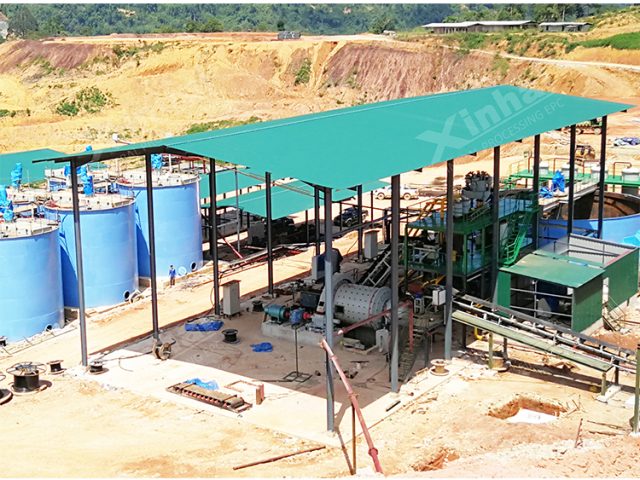
3,000 t/d Gold Plant — Guinea
On a 1.2 g/t feed grade, overall recovery has stayed steady at roughly 93%.
Read case →
500,000 t/a Wollastonite Mining — Jiangxi, China
Standardised mining practice implemented across the operation, with ore dilution held strictly below 5%
Read case →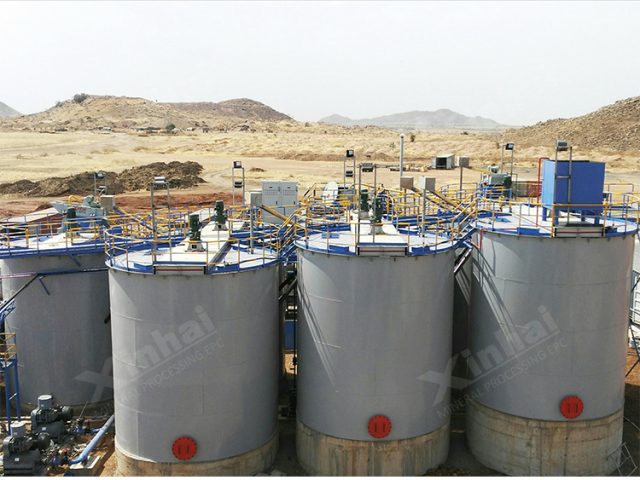
500 t/d Gold Plant — Zimbabwe
Mining and processing flow customized and optimized to the orebody to maximize resource recovery, with standardized…
Read case →