
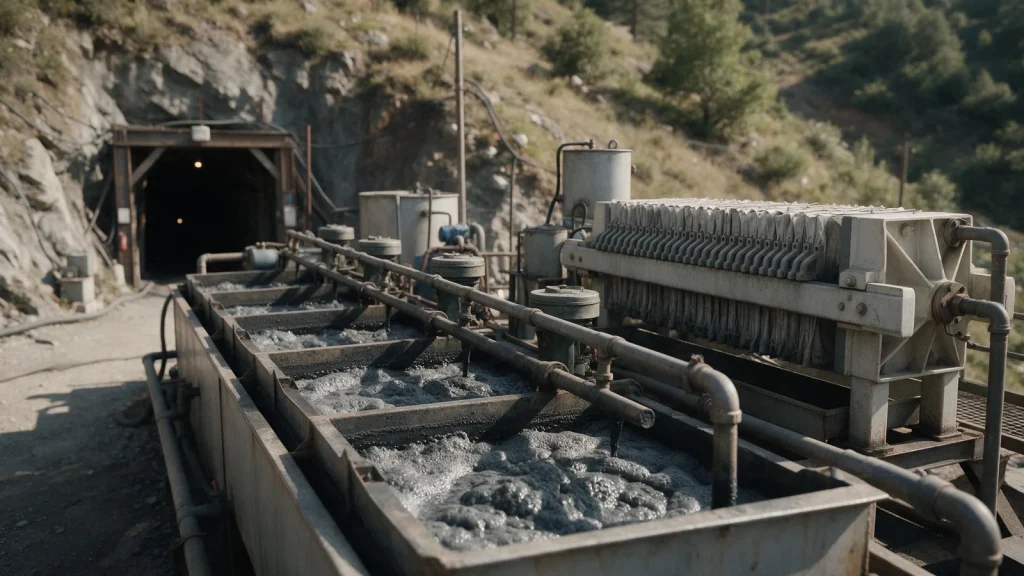
Typical process flow
- 1Crushing and fine-ore storage
Two-stage or two-and-a-half-stage closed-circuit crushing to ball-mill feed, with a fine-ore bin that buffers underground hoisting.
- 2Grinding and classification
Ball mill in closed circuit with a classifier or hydrocyclones, typically to about P80 75-150 micrometres depending on liberation.
- 3Lead-silver priority flotation
Roughing, scavenging and two or more cleaning stages float galena and silver minerals while zinc is depressed.
- 4Gravity or regrind where needed
Coarse native silver or middlings may justify a gravity step or concentrate regrinding; testwork decides.
- 5Optional zinc circuit
A separate zinc flotation is added only when zinc grade and tonnage make a saleable concentrate.
- 6Dewatering and tailings
Concentrate thickening and filtration; tailings thickened for disposal with process water returned.
Header image: illustrative, not a photograph of a specific project.
Say a mine owner asks what size lead ore processing plant makes sense for a small underground lead-silver operation. They’re not after a textbook. They want to know what works at 100 to 500 t/d, what the plant handles, and what they’ll have to supply before anyone can quote. That’s what this page covers. You’ll notice the emphasis on testwork and flowsheet, not on a fixed flowsheet copied from a catalogue.
Ores and grades this plant suits
Galena-dominant lead-silver ores are the natural feed here. Cerussite and anglesite show up as secondary lead minerals, especially in oxidised zones near the surface. Minor zinc is expected; it doesn’t change the core flowsheet at these tonnages. What changes is how much of that zinc ends up worth separating. A small plant can float lead and silver into one concentrate, but you need to know your zinc mineral first. Sphalerite behaves differently from marmatite, and both behave differently from oxidised zinc. That’s why a single head grade without mineralogy won’t tell you the flowsheet.
Feed grade varies too much to be useful as a fixed threshold. What matters is the concentrate you can sell. For a small lead-silver mine, the target is usually a lead-silver concentrate with roughly 45 to 65 per cent lead and 300 to 3,000 g/t silver. Those are typical market grades, not a guarantee. If your ore contains enough sphalerite to justify a separate zinc circuit, you’ll add one after lead flotation. In many small mines, zinc stays in the tailings or pays a penalty, and a broader lead-zinc processing route may be discussed.
Coarse native silver deserves its own look. If silver reports as free metallic grains, a conventional flotation circuit can lose it in the cyclone underflow or in coarse scavenger tails. Gravity or a regrind mill on the rougher concentrate often becomes necessary. The decision is testwork driven, not a design assumption. A small hand-held table run on a rougher concentrate sample will often settle the question in a day.
Capacity range
This page focuses on 100 to 500 t/d. That range suits small underground operations with a defined mine life and an orebody that can’t feed a 1,500 t/d plant. Common modular steps are 300 and 500 t/d, because they match standard ball mill sizes and containerised equipment. You won’t get a useful payback calculation from a catalogue; it depends on orebody size, grade continuity and mining cost. A 1,500 t/d polymetallic plant is a different animal, closer to an expansion case than a first concentrator. If you’re sitting on a small high-grade vein system, 150 t/d may be all the ore you can reliably hoist in a year. If you’re sitting on a broader disseminated zone, 500 t/d might be the lower bound.
Don’t start with a capacity. Start with the mine plan. A 300 t/d plant on a ten year orebody has very different economics from a 500 t/d plant on a four year orebody. The concentrator must fit the stoping sequence, not the other way round. Modular plants shine here because you can add a second line later without redoing the whole pad.
Typical flowsheet
You’ll see a familiar sequence at this tonnage. Two-stage crushing and a fine ore bin, then a ball mill in closed circuit with a hydrocyclone. The target grind is usually P80 between 75 and 150 µm, but liberation on your ore sets that. Grind too coarse and you lose galena in tails. Grind too fine and you pay for slimes and reagent burn. A locked-cycle test will show the knee point, where recovery gain flattens and comminution cost climbs.
Then comes lead-priority flotation. Zinc is depressed with reagents, while lead and silver are floated in a rougher bank. Scavenger cells catch what the rougher misses, and the rougher concentrate goes through two or more cleaning stages. That’s the standard small plant arrangement: rough, scavenge, clean, reclean. A gravity stage or concentrate regrind can sit before cleaning if coarse native silver is present. Coarse silver is heavy; a table or a small regrind mill recovers it before it gets ground into fines that float poorly. Sometimes the regrind mill is a small ball mill, sometimes it’s a stirred mill. The choice depends on the grind target and the mineral carrying the silver. Bulk flotation with concentrate regrinding is an alternative when zinc is high enough to matter but too fine to float separately from the start.
Lead-silver concentrate is thickened and filtered. Tailings go to a thickener, and water returns to the process. Don’t underestimate tailings water return in a small underground mine: fresh water is often expensive or seasonal above ground. For a deeper look at how these flowsheets are developed, the mineral processing plant design guide covers the testwork and design loop.
On silver processing more broadly, you’ll see similar sequences, but the small lead-silver case is tighter because you’re running two metals into one concentrate on purpose. You don’t have the spare capacity to absorb a bad regrind decision.
What Xinhai delivers
The scope is not just equipment. A small plant supplier should deliver testwork, process design, equipment manufacturing and procurement, construction, installation and commissioning. The standard delivery model is EPC+M+O. The M and O pieces are where many small mines fail: construction management and then operation management once the plant is running. The table below compares the common delivery options.
| Delivery option | Owner responsibility | Supplier responsibility | Best fit for 100 to 500 t/d |
|---|---|---|---|
| EPC | Site, permits, ore, final operation | Design, procurement, construction, commissioning | Owners with an operating team but no construction team |
| EPCM | Contracts, procurement risk, operations | Design, procurement management, construction management | Owners who want control of procurement |
| EPC+M+O | Site, permits, ore, commercial offtake | EPC scope plus mine construction management and operation management | Small mines without a full technical team |
Xinhai reports a 500 t/d silver flotation plant in Morocco with silver recovery of 83.95%, contracted in late 2016 and commissioned in the first half of 2017. That’s one project, not a promise for yours, but it shows the small silver flotation route in operation. Xinhai holds ISO 9001:2015, ISO 14001:2015 and ISO 45001:2018 management system certifications. Published project records also include a 1,500 t/d copper-lead-zinc plant in Mexico and another in Armenia. If your project will report under an Australian listing, the JORC Code sets the minimum standard for public reports, and any competent engineer should know what that means for your reserve statement.
Schedule
A small 500 t/d lead-silver plant typically takes 12 to 18 months from testwork to ramp-up, assuming a greenfield site and normal logistics. That’s not a figure you can fix on day one, but it’s the planning range used in most small flotation projects. Design runs two to four months, manufacturing and procurement four to seven months, shipping and customs one to two months, civil and installation five to eight months, and commissioning one to two months. Brownfield sites with power and permits ready can shorten that to roughly 10 to 14 months. Remote greenfield sites with poor road access can stretch it to 18 to 24 months.
Xinhai’s Henan 1,500 t/d silver-lead-zinc-gold polymetallic expansion EPC started in early April 2024 and was commissioned in early November 2024. That’s about seven months, which is fast for an expansion, but it’s a 1,500 t/d brownfield case, not a small greenfield plant. For your project, ask each bidder which phase they’ll run in parallel. Procurement and civil work usually overlap; if they don’t, your schedule is already longer than it needs to be.
What we need from you to quote
You can’t get a useful quote from an email that says ‘300 t/d lead-silver, send price.’ You’ll need a representative sample, split by orebody zones, not a single grab from the muck pile. A full multi-element assay matters: Pb, Zn, Ag, Au, S, Fe, As, Sb at minimum. Ask your lab for that list, not just Pb and Ag. Mineralogy matters too: liberation size, clay content, Bond work index and abrasion index. If you have existing testwork, send it all.
Site data comes next: target throughput, plant location, power supply, water source, road access and climate. Then the product plan. Do you want a lead-silver concentrate only, or a separate zinc concentrate? That decision changes the flowsheet and the costs. Finally, state your environmental and tailings requirements. For air permits, ask your supplier to use published AP-42 metallic minerals processing emission factors so the permit application is based on published methods, not a guess.
Send the ore data, not a long email, through the inquiry form below or the contact page.
Frequently Asked Questions
How much does a lead ore processing plant cost?
Cost isn't a fixed number. A 100 to 500 t/d plant price depends on capacity, site access, power availability, testwork, reagent scheme, equipment scope, and whether you buy EPC or EPC+M+O. Ask for a budget once you have a representative sample and a flowsheet; before that, any number is a guess.
What is the typical recovery for a small lead-silver flotation plant?
There isn't a single typical recovery. Lead and silver recovery depends on liberation size, oxidation, clay content, and reagent selection. Ask any supplier for locked-cycle test results on your own sample. A number from a textbook or another mine won't predict your plant.
When should a lead-silver plant add a separate zinc circuit?
Add a zinc circuit when sphalerite content and zinc price together support the extra flotation, regrind, dewatering and concentrate transport. If zinc runs below the threshold where it can support its own circuit, it often makes more sense to leave zinc in tailings and sell a lead-silver concentrate. Testwork on your ore decides the threshold, not a rule of thumb.
What information do I need to get a quote for a lead ore processing plant?
You'll need a representative sample split by orebody zones, a full assay suite including Pb, Zn, Ag, Au, S, Fe, As and Sb, mineralogy and liberation size, clay content, Bond work index, abrasion index, target throughput, site location, power and water data, and your product plan. Send that through the inquiry form; a short email asking for a price won't produce a useful bid.
Send your ore data for a flowsheet and quote
Ore type, grade, target capacity and country are enough for a first scoped reply.
Related projects
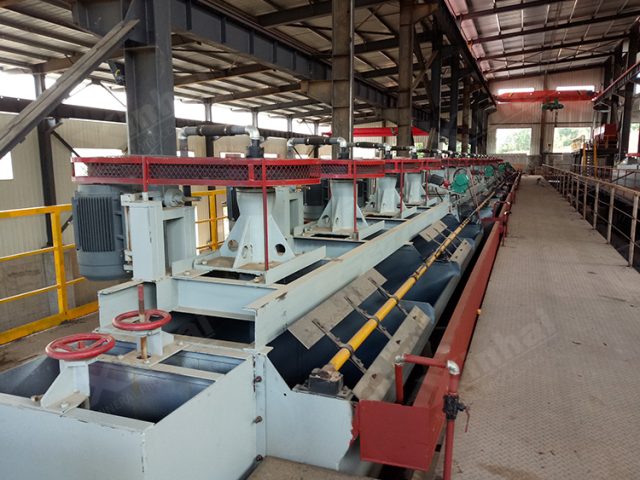
1,500 t/d Copper Plant Design — Pakistan
A design-only (E) engagement for a 1,500 t/d copper concentrator; Xinhai's recorded scope was engineering and…
Read case →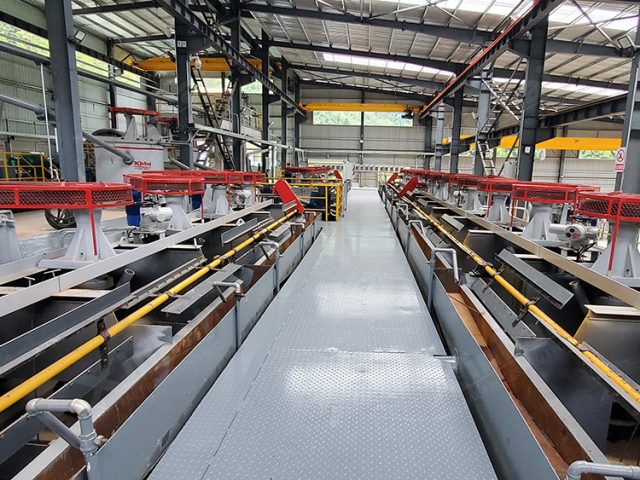
1,200 t/d Fluorite Plant — Italy
Xinhai's first full-scale EPC project in Europe, delivered with CE certification across the whole scope.
Read case →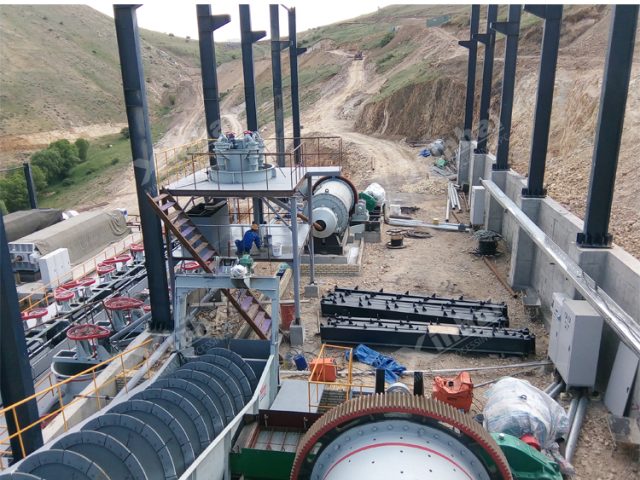
2 Mt/a Spodumene Lithium Plant — Zimbabwe
Mill throughput 7.6% above design capacity, 95.7% equipment utilization, concentrate grade held above 5.5%, recovery raised…
Read case →