
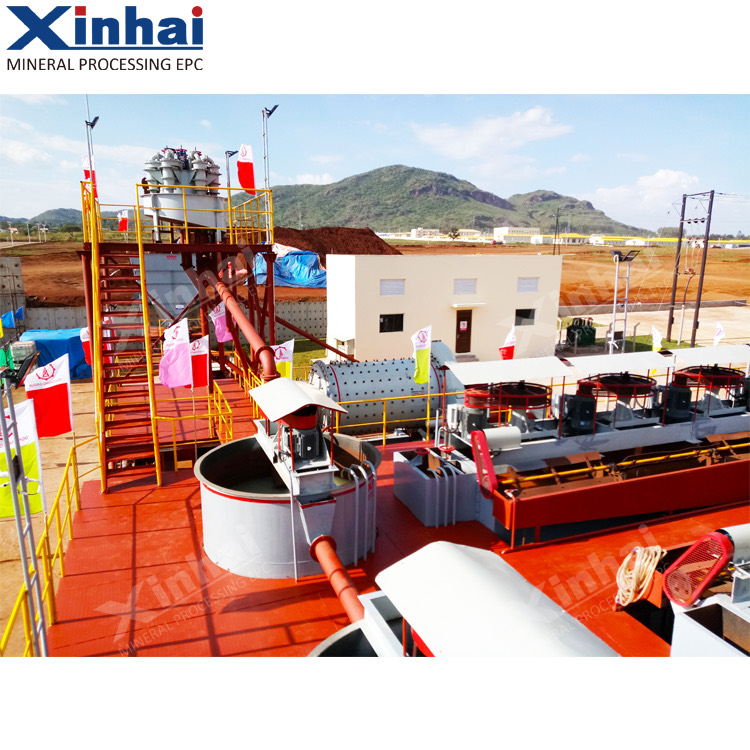
Typical process flow
- 1Screening & scrubbing
Clay comes off first in a scrubber, what is left gets screened, and each size fraction goes to a different part of the gravity circuit, because an unclassified feed defeats any gravity unit downstream.
- 2Crushing & grinding (hard-rock)
Crushing followed by grinding to the liberation size of the chromite grains, and no finer, since over-grinding produces slimes the gravity circuit struggles to recover.
- 3Coarse gravity — jigs
Jigs take the coarse, well-liberated end of the feed at high tonnage and low operating cost, usually on material above roughly half a millimetre.
- 4Fine gravity — spirals & tables
Spirals work the 75 µm–3 mm window reported in the SAIMM spiral study cited further down this page. Below that size water drag starts to beat gravity, and a shaking table or a dedicated fine circuit takes over.
- 5Magnetic cleaning
High-intensity magnetic separation is what moves the Cr2O3:Fe ratio, since gravity on its own rarely does. Which fraction is product depends on the ore, because some chromite is itself weakly magnetic.
- 6Dewatering & tailings
Thickeners and filters return process water to the circuit and bring the concentrate down to a moisture content the buyer and the haulier will accept.
Why chrome ore beneficiation starts with density
Chromite is dense. The Handbook of Mineralogy lists a measured density of 4.5–4.8 g/cm³, and the serpentine, olivine and pyroxene it grew up with sit well below that. The gap is what a chrome plant sells. Liberate the grains properly and gravity does most of the separation, without the power draw and the reagent bill a full flotation circuit brings.
Two specifications decide what you get paid. One is Cr2O3 grade; the other is the chromium-to-iron ratio, and the ratio is where most contract arguments happen, because iron sits inside the chromite lattice itself as well as riding along in the gangue, which means a circuit that does nothing except reject light silicates can hit its grade target and still miss the ratio the smelter is buying against. Written grade bands do exist. U.S. customs classifies chromium ores and concentrates in three Cr2O3 brackets, reprinted each year in the USGS Mineral Commodity Summaries: not more than 40%, more than 40% but less than 46%, and 46% or above. Those are tariff lines, not commercial terms. Your own offtake contract will name its own Cr2O3 floor and its own Cr:Fe minimum, the two may not line up with the customs brackets at all, and the contract is what the circuit gets designed against.
So where does the demand come from? Ferrochromium, and through it stainless steel. USGS is blunt about the dependency: chromium has no substitute in stainless steel, its leading end use. The same summary names South Africa as the leading chromite ore producer, which is one reason so much of the working vocabulary in chrome processing comes out of the Bushveld.
Alluvial and placer chrome ore
Alluvial chrome is the easy case, up to a point. The chromite has already been freed from its matrix, so grinding is off the table, and what you’re fighting instead is clay, oversize, and a feed size distribution that wanders from week to week as the pit moves. Scrubbing breaks the clay down, screening splits the feed, and each size fraction then goes to the unit that suits it.
A jig takes the coarse end at high tonnage and low operating cost, earning its keep on material above roughly half a millimetre. A spiral chute separator covers the middle of the distribution with no moving parts and modest water use, and it has a published operating window: Molefe and Baloyi, writing for the Southern African Institute of Mining and Metallurgy, put the optimum spiral feed size at 75 µm–3 mm. A shaking table makes the sharpest cut at the fine end, down toward a tenth of a millimetre, though each deck only handles so much tonnage, which is why tables usually appear as a cleaning stage.
Exactly where the jig hands over to the spiral, and the spiral to the table, is read off your own size-by-size assay. Split a representative feed sample into screen fractions and assay each one for Cr2O3 so you know where the metal actually sits, then run a pilot unit and treat its tails the same way; the fraction where recovery falls off is the fraction that belongs on the next machine down. Two or three of those tests fix the whole size allocation, which is cheap next to rebuilding a circuit that leaks at one end.
Our complete chrome ore processing plant packages scrubbing, screening and a staged gravity circuit into a single line, fixed or mobile, and the full gravity concentration equipment range lets us match unit types to the size distribution the deposit actually delivers. One device stretched across the whole size range leaks chromite at both ends, and you’ll see it in the tails long before anyone notices it in the concentrate.
Hard-rock and disseminated chromite
Massive and disseminated ore has to be crushed and ground, and the grind target is the single decision that most affects what the plant recovers. Comminute only as far as liberation demands. Go finer than that and you manufacture slimes, which is where chrome recovery quietly disappears.
That target comes out of the mineralogy — chromite grain size, how it is intergrown with silicate, how much of the iron is structural and how much is gangue-borne — and it gets settled before any layout is fixed. Bench work runs in a CNAS-accredited laboratory under ISO/IEC 17025, and continuous runs at an industrial-scale pilot base then show whether the bench result survives at tonnage. Xinhai reports roughly 200 ore-dressing test programmes a year across more than 70 ore types, and chrome sits in that queue alongside iron, copper and titanium work.
Grinding hardware comes from the same house that designs the circuit. Xinhai machines ball mills up to 7 m in diameter in its own plants, so mill selection isn’t constrained to a catalogue somebody else prints. For the underlying trade-offs between unit types, our guide to gravity concentration equipment is a good starting point, and wet ball mill sizing follows the same test data.
Fine chromite: where a chrome plant loses recovery
Every chrome deposit makes fines, and fines don’t play by the rules the coarse circuit was designed around. Below the spiral window the physics turns against you. The same SAIMM paper reports that ultrafine particles under 53 µm tend to report to the tailings on a traditional spiral, because the force from water flow starts to outrank gravity as particle size drops. That loss stays invisible for as long as nobody looks at the fine end of the tails.
Practically, there are three answers, and most plants end up using more than one of them. Desliming early with a hydrocyclone separator pulls the fine stream out so it can be treated on its own terms. Enhanced-gravity units extend the recoverable range downward. Flotation is the third route for fine chromite, and it isn’t a theoretical one for our engineering team, since Xinhai’s project register includes a 3,000 t/d chromite flotation plant in South Africa. Classification decisions in general are covered in spiral classifier vs hydrocyclone.
Chrome-to-iron ratio: what the smelter is buying
Gravity lifts Cr2O3 grade, but it doesn’t reliably fix the ratio, because iron-bearing gangue — magnetite, iron-stained silicates, altered material along fractures — can follow chromite straight through a density separation whenever its density is not different enough to matter.
High-intensity magnetic separation is the usual correction, and how it gets applied depends on the ore, which catches people out: chromite itself can be weakly magnetic, as the Handbook of Mineralogy notes for some samples, so on one feed the magnetic fraction is the product and on another feed it is the reject. Which of those you have comes out of a magnetic test on your own material. A dry magnetic separator suits dry, coarse, arid-site duty, while a wet drum magnetic separator fits a circuit already carrying slurry. The choice logic is laid out in wet vs dry magnetic separation, and the full magnetic separation range covers both. The target ratio itself comes from your offtake specification and gets designed into the circuit from the start.
Dewatering, water recovery and tailings
Concentrate has to leave the site at a moisture content the buyer and the haulier will accept, and process water has to come back. Thickeners do the heavy lifting on water recovery, and a deep cone thickener pushes underflow density higher where water is scarce or where the tailings facility needs a thicker deposit. Final concentrate moisture is trimmed on a filter press or a vacuum filter. The trade-off between the two families is set out in tailings dewatering: thickener vs filter press, and the wider thickening and dewatering range covers the equipment side.
The tailings facility is drawn by the same institute that draws the plant. Our design institute integrates 17 disciplines (mining, mineral processing, civil, electrical, automation, geology, water, tailings, general layout and the rest) under one roof, so the storage facility, the water balance and the plant layout get resolved together rather than handed between three consultants who never meet. On chrome that integration earns its money quickly, because a fines-heavy tailings stream changes the water balance and the deposition plan at the same time.
How we deliver a chrome ore processing plant
Xinhai works as an EPC+M+O contractor. Engineering covers ore testing, feasibility work and full-cycle mine design, with study stages aligned to JORC, NI 43-101 and VALMIN where your financing requires it. Procurement and manufacturing are in-house: three intelligent manufacturing bases totalling around 110,000 m² of plant area, more than 1,000 equipment models, and a dedicated modular and prefabricated base for plants that need to ship as skids. Construction, commissioning, construction management and operations round out the M and the O, including operator training, spares and expansion support once the plant is running.
Inside China, mine construction work is carried out under a Class-A general contracting qualification for mine construction projects held by the group’s construction company. Overseas scopes are structured around local law, local permitting and local contracting practice, which is a different conversation on every continent. Xinhai reports more than 600 mine EPC+M+O projects in over 100 countries and regions, according to the company’s published figures.
For the shape of a full delivery, our project case studies show completed plants end to end, and what mineral processing EPC covers explains where the contract boundaries usually land. Related flowsheets sit under mineral processing solutions. To size a chrome plant against your own deposit, send us a sample and a target specification, then contact us for an ore test.
Sources
- USGS, Mineral Commodity Summaries 2026 — Chromium. Cited here for three things: South Africa as the leading chromite ore producer; chromium having no substitute in stainless steel, its leading end use; and the three Cr2O3 brackets in the U.S. tariff schedule (not more than 40%, more than 40% but less than 46%, 46% or more), which are customs classifications rather than commercial contract terms.
- T. Molefe & H.S. Baloyi, “Recovery of ultra-fine chrome with spiral concentrators — where are we?”, 8th International PGM Conference, Southern African Institute of Mining and Metallurgy (2022). The 75 µm–3 mm optimum spiral feed window comes from this paper, together with the finding that ultrafine particles below 53 µm report to the tailings on a traditional spiral once water-flow forces outweigh gravity at fine sizes.
- Handbook of Mineralogy — Chromite (Mineralogical Society of America). Origin of the measured density quoted above, 4.5–4.8 g/cm³, and of the note that some chromite samples are weakly magnetic.
Frequently Asked Questions
Why is gravity separation used for chrome ore?
Density. The Handbook of Mineralogy gives chromite a measured density of 4.5–4.8 g/cm³, well above the silicate gangue it is usually locked in with, and that gap is large enough for jigs, spirals and shaking tables to make a clean split at low operating cost. Gravity also avoids the reagent bill and the water chemistry a full flotation circuit brings. It is the backbone of most chrome flowsheets, with magnetic separation added when the chrome-to-iron ratio needs work.
Do I need to grind alluvial chrome ore?
Usually not. Placer and alluvial chromite is already free of the matrix, so it only needs scrubbing to break down clay and screening to size before gravity concentration. Grinding belongs to hard-rock ore, where chromite grains have to be freed from silicate — and even then only as fine as liberation demands, because over-grinding makes slimes that gravity units struggle to recover.
Where does a chrome plant lose the most chromite?
In the fines. Molefe and Baloyi, in a paper for the Southern African Institute of Mining and Metallurgy, put the optimum spiral feed window at 75 µm–3 mm and report that ultrafine particles below 53 µm tend to report to spiral tailings, because water-flow forces outrank gravity as particles get smaller. Desliming and treating the fine stream separately, by enhanced-gravity units or by flotation, is how that loss is attacked. Size and assay your tails by fraction, or you will never see it.
How do I raise the chrome-to-iron ratio?
Gravity lifts Cr2O3 grade but does not reliably fix the ratio, because iron-bearing gangue can be close enough in density to follow chromite through. High-intensity magnetic separation is the usual correction. Note that chromite itself can be weakly magnetic, so on some feeds the magnetic fraction is the product and on others it is the reject, and a magnetic test on your own material settles which. The target ratio comes from your offtake specification and is designed into the circuit.
Send your ore data for a flowsheet and quote
Ore type, grade, target capacity and country are enough for a first scoped reply.
Related projects
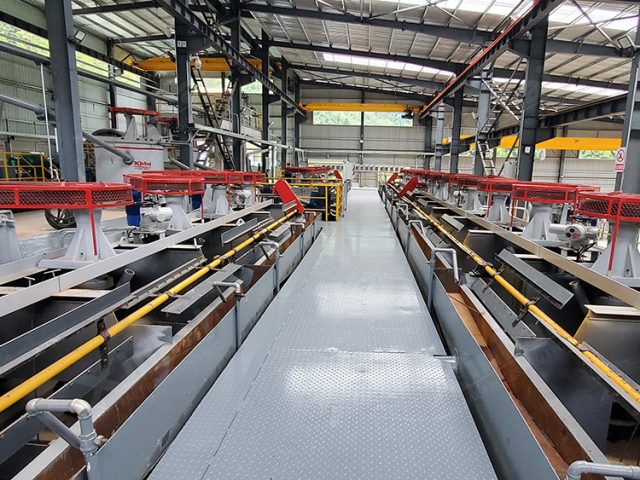
1,200 t/d Fluorite Plant — Italy
Xinhai's first full-scale EPC project in Europe, delivered with CE certification across the whole scope.
Read case →
500,000 t/a Wollastonite Mining — Jiangxi, China
Standardised mining practice implemented across the operation, with ore dilution held strictly below 5%
Read case →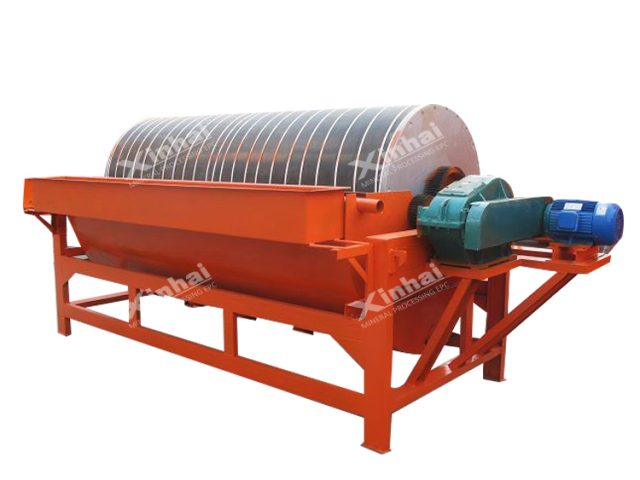
3,500 t/d Iron Ore Plant — Mongolia
Primary iron concentrate at ≥65% Fe with a yield of about 31%, plus a secondary concentrate…
Read case →