
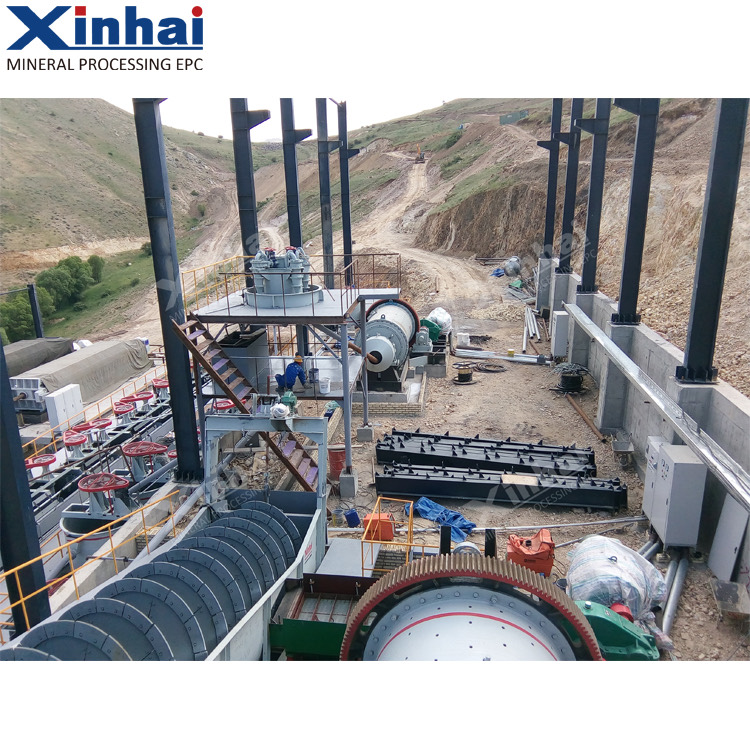
Typical process flow
- 1Crushing & screening
Three-stage crushing reduces pegmatite ore to a DMS feed size, with screening to split off the fines that DMS cannot treat.
- 2Dense-media separation (DMS)
Coarse spodumene is pre-concentrated in a ferrosilicon medium, rejecting low-density gangue and cutting downstream flotation load.
- 3Grinding & desliming
DMS middlings and fines are ground to liberate spodumene, then deslimed by hydrocyclone ahead of flotation.
- 4Mica & spodumene flotation
Mica is floated off first, then spodumene is floated with fatty-acid collectors after alkaline conditioning to recover the fine fraction.
- 5Magnetic iron removal
High-intensity magnetic separation strips iron-bearing minerals so the concentrate meets the iron limit written into your offtake spec.
- 6Dewatering & tailings
Concentrate is thickened and filtered to a transport moisture; thickeners recover process water and manage tailings.
What spodumene ore actually hands you
Pegmatite is a messy feed. Spodumene sits in a matrix of quartz, feldspar and mica, iron minerals ride along with it, and on some deposits petalite carries a fair share of the lithium as well. Your converter cares about one line on the assay sheet and very little else. When Geoscience Australia converts national spodumene output into contained lithium, it works on the assumption of 6% Li2O in spodumene concentrates, and that is the reference grade the market quotes.
So the flowsheet carries two jobs at once. It has to raise the lithium grade, and it has to strip the contaminants that would get a high-grade concentrate discounted after the grade was already reached.
Coarse, well-liberated spodumene is cheap to upgrade by density. Fine, intergrown spodumene isn’t — it has to be floated. Where that split falls is a property of your deposit, and guessing at it is how plants end up with a DMS module that rejects lithium or a flotation circuit twice the size it needed to be. Every lithium job we take starts in the lab, and Xinhai reports a CNAS-accredited laboratory to ISO/IEC 17025 at its mineral research institute, alongside an industrial-scale pilot base and roughly 200 ore-dressing test programmes a year across more than 70 ore types.
Why DMS goes in front of the mill
Dense-media separation earns its keep by throwing mass away before you pay to grind it. Crushed ore meets a ferrosilicon-in-water medium; low-density quartz and feldspar float off, dense spodumene reports to sinks, and the tonnage arriving at the mill drops with it. You’ll see that in lower grinding energy, lower reagent consumption, and a flotation circuit sized smaller for the same tonnes of concentrate leaving the gate.
The catch is particle size: a 2025 review in Scientific Reports places practical DMS duty in the coarse range of roughly 0.5–75 mm, and says plainly that flotation is still required for the middlings and the undersize falling outside that window. DMS is a pre-concentrator, one stage in a longer line, and the share of feed it can actually treat is read straight off the screen analysis of the crushed ore.
On the 2 Mt/a spodumene project in Zimbabwe our test team met this from the opposite direction. Petalite in that ore would not separate cleanly by flotation, so the programme moved to heavy-medium separation: tetrabromoethane heavy-liquid work at bench scale first, then pilot runs on a ferrosilicon medium to prove the density cut held at scale. The flowsheet that came out of it reads crushing and screening, HMS to recover petalite, grinding and classification, gravity recovery of tantalum and niobium, desliming, mica flotation, spodumene flotation. Look at where gravity sits in that sequence. A tantalum-niobium by-product pulled mid-circuit is revenue that goes to the tailings dam whenever nobody assays for it. Our crushing equipment and gravity concentration lines cover that whole front end.
Grinding, desliming and the flotation circuit
DMS middlings and the fine fraction go to a wet ball mill, then onto a hydrocyclone for desliming. Grind size is a trade in both directions: grind coarse and spodumene stays locked to its quartz and feldspar neighbours; grind harder than liberation requires and you are manufacturing slimes that consume collector and flatten selectivity. The number to work to comes off the liberation curve — mill to the point where the degree-of-liberation curve flattens out, because past that knee the extra kilowatt-hours mostly buy you slimes.
Flotation then runs in stages, because spodumene will not simply float on demand. Mica goes first. The spodumene surface then has to be conditioned in an alkaline pulp before a fatty-acid collector will hold on it. A 2024 review in the International Journal of Molecular Sciences attributes the chemisorption of sodium oleate on spodumene to unsaturated aluminium sites on the mineral surface. Surface condition and pulp chemistry carry much of the result between them. Where fatty acids run out of selectivity, hydroxamate collectors are the usual alternative, and attrition scrubbing ahead of desliming cleans the spodumene surface before conditioning starts.
Slimes do the rest of the damage: the Scientific Reports review lists the inadvertent entrainment of fine particles, and the desliming steps it forces, among the standing challenges in lithium beneficiation. It adds that the foaming behaviour of fatty acid collectors itself drags fine gangue into the froth. Desliming sits ahead of the rougher for that reason.
Cell volume follows from throughput and the residence time the rougher needs. A JJF flotation machine circuit suits spodumene rougher and cleaner duty, and the broader flotation equipment range scales up from there. If you want the whole line packaged as one delivery, that’s our spodumene lithium processing plant; if you want the reagent-by-reagent walkthrough, read the spodumene processing flowsheet guide.
Iron decides whether the concentrate sells
You can hit grade and still be rejected on iron. Lithium chemical plants write an iron ceiling into the offtake contract, and a concentrate over that ceiling doesn’t always get refused outright; more often it turns into a discount argument you lose. High-intensity magnetic separation on a wet drum magnetic separator is how the flowsheet answers it. The Scientific Reports review notes magnetic separation can sit either during or after flotation to pull iron impurities out of lithium concentrates. Which position suits your ore depends on where the iron reports, which is why the test work has to locate the iron-bearing minerals before the flowsheet is fixed.
Water, tailings and the back end
Concentrate is thickened and filtered down to a transport moisture before it goes anywhere. Tailings thickeners claw process water back into the circuit, and on the semi-arid pegmatite belts where a lot of hard-rock lithium sits it’s a bigger deal than it sounds. A deep cone thickener paired with a filter press is the usual arrangement, and our comparison of thickener versus filter press for tailings dewatering covers when each one wins. We design the tailings facility itself inside the same engineering package.
What the numbers looked like on real ore
Two data points from our own archive, both out of project records. On the 2 Mt/a Zimbabwe spodumene plant we run under an EPC+M+O contract, mill throughput came in 7.6% above design capacity with equipment availability at 95.7%. Concentrate grade held above 5.5%, recovery moved from 59.5% to 69%, and annual concentrate output rose by roughly 70,000 tonnes. From signature to production took 364 days. The plant write-up is here: 2 Mt/a spodumene plant, Zimbabwe.
The second is a Canadian tailings retreatment programme. Feed assayed 1.2% Li2O with 0.46% Cs2O and 0.5% Rb2O, and the test route recovered a lithium concentrate at 3.83% Li2O with 57.92% recovery, alongside mica, caesium, feldspar and quartz products. Retreatment work like that is worth pricing before anyone assumes a lithium project has to start with a greenfield orebody, because dumps built under cruder flowsheets can still carry payable lithium alongside saleable by-products.
How the plant gets delivered
We work as an EPC+M+O contractor, which covers ore testing, feasibility study, full mine design, equipment manufacture, construction, commissioning and, if you want it, operating the plant afterwards. The design institute pulls 17 disciplines under one roof — geology, mining, mineral processing, civil, electrical, automation, tailings, general layout and the rest — and reporting can be framed to JORC, NI 43-101 or VALMIN for your financiers. Equipment comes out of our own plants, so grinding, flotation and thickening get sized in-house: ball mills up to φ7 m, flotation cells up to 320 m³, thickeners up to φ100 m, and single projects scoped as far as 50,000 t/d. Xinhai reports more than 600 mine EPC+M+O projects across 100-plus countries and regions according to the company’s published figures.
Where to start? Send us a sample of the ore and the offtake spec you have to meet. The EPC service overview explains how the stages hand off, and other commodities sit under mineral processing solutions. To get a sample moving, contact us for an ore test.
Sources
- Geoscience Australia, Australia’s Identified Mineral Resources 2025 Preliminary Tables. Supports the statement that 6% Li2O is the reference grade used for spodumene concentrates (its table notes state lithium production is estimated assuming 6% Li2O in spodumene concentrates).
- Opoku et al., “An overview of coarse particle beneficiation of lithium ores”, Scientific Reports, 2025. Supports the DMS working size range of roughly 0.5–75 mm, the need for flotation on middlings and undersize, the ferrosilicon dense medium, magnetic separation for iron removal from lithium concentrates, and the inadvertent entrainment of fine particles that makes desliming necessary, including entrainment of fine gangue caused by the foaming behaviour of fatty acid collectors.
- Retamal et al., “Molecular Design and Spodumene Flotation — A Review”, International Journal of Molecular Sciences, 2024. Supports one point only: that the chemical adsorption of sodium oleate on spodumene is attributed to unsaturated aluminium sites on the mineral surface.
Frequently Asked Questions
Why use DMS before flotation on spodumene?
Dense-media separation rejects low-density quartz and feldspar by density before grinding, so you stop paying to mill and float waste rock. It only works in the coarse size range, which a 2025 Scientific Reports review puts at roughly 0.5-75 mm, and middlings plus undersize still have to be floated. On hard-rock lithium the two are designed as a pair, with the screen analysis of the crushed ore deciding how much duty each one carries.
What concentrate grade should a spodumene plant target?
Six per cent Li2O is the market reference grade; Geoscience Australia estimates national lithium production assuming 6% Li2O in spodumene concentrates. Reaching it takes mica removal, spodumene flotation and iron control working together. What your own deposit will support turns on three things: how much of the lithium sits in spodumene rather than petalite or mica, how coarsely the spodumene liberates, and how much iron has to come out to stay inside the offtake ceiling.
How is iron removed to meet the offtake spec?
High-intensity magnetic separation strips iron-bearing minerals from the concentrate. Published reviews of lithium beneficiation note it can run during or after flotation, and where it sits depends on which minerals carry the iron. An iron ceiling is written into the offtake contract, so that limit is designed into the flowsheet from the start.
What lithium recovery is realistic?
Recovery turns on spodumene liberation, how much lithium sits in petalite or mica, slimes generation and the reagent regime, so it is settled by test work before the flowsheet is fixed. One documented reference: on the 2 Mt/a Zimbabwe spodumene plant we operate, recovery moved from 59.5% to 69% with concentrate grade held above 5.5%.
Send your ore data for a flowsheet and quote
Ore type, grade, target capacity and country are enough for a first scoped reply.
Related projects
1,200 t/d Fluorite Plant — Italy
Xinhai's first full-scale EPC project in Europe, delivered with CE certification across the whole scope.
Read case →
3,500 t/d Iron Ore Plant — Mongolia
Primary iron concentrate at ≥65% Fe with a yield of about 31%, plus a secondary concentrate…
Read case →
4,000 t/d Molybdenum Mine Development — Hebei, China
Ramp and ventilation shaft construction accelerated, with key milestones completed ahead of schedule behind a fully…
Read case →