
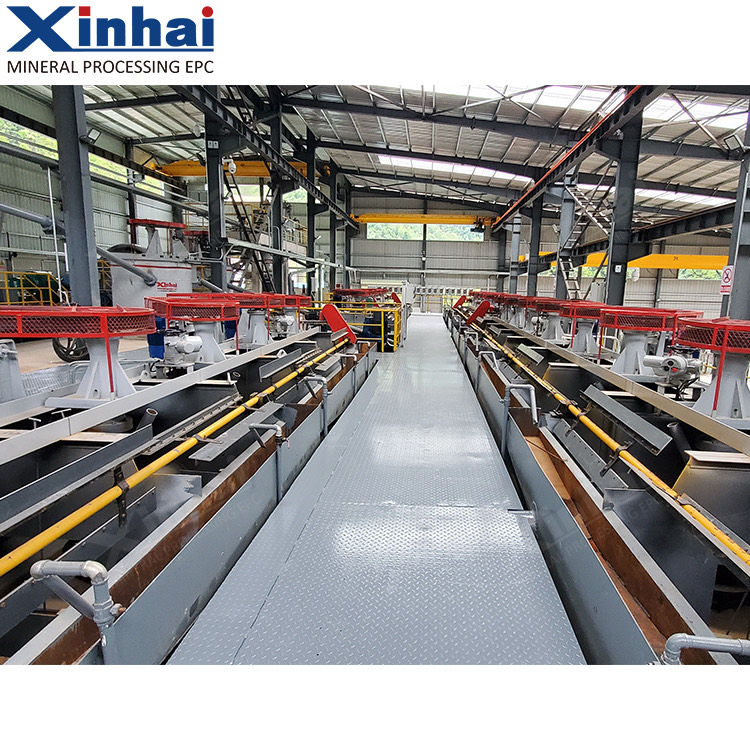
Typical process flow
- 1Crushing & screening
Run-of-mine ore is reduced in two or three stages to ball-mill feed size using jaw and cone crushers in closed circuit with screens, with the stage count set by feed top size and ore competency.
- 2Grinding & classification
A wet ball mill in closed circuit with hydrocyclones grinds to the liberation size established by testwork, freeing galena and sphalerite without over-generating slimes.
- 3Lead flotation (galena first)
Galena is floated in a rougher-scavenger-cleaner circuit while sphalerite and pyrite are held down with zinc sulphate and lime, producing a lead concentrate.
- 4Zinc flotation (activate then float)
The lead-circuit tailing is conditioned with copper sulphate to activate sphalerite, then floated at raised pH to make a separate zinc concentrate.
- 5Dewatering & tailings
Each concentrate is thickened and filtered to a shippable cake; tailings are thickened with process water recycled to the plant.
Galena and sphalerite grow up together. Same orebody, same sulphide collectors, both happy to float. That’s the whole problem. The difficulty in a lead-zinc plant has nothing to do with persuading the sulphides to float; they float far too easily. It’s that you have to float them one at a time.
Lead, zinc and silver arrive as a package
Where does lead actually come from? Rarely from a lead mine. The USGS Mineral Commodity Summaries 2025 records U.S. lead as produced by five lead mines in Missouri plus as a byproduct at two zinc mines in Alaska and two silver mines in Idaho. Much of the country’s lead falls out of somebody else’s zinc or silver operation. The same chapter notes that significant lead resources have been identified in association with zinc and (or) silver or copper deposits in Australia, China, Ireland, Mexico, Peru, Portugal, Russia and the United States (Alaska).
Silver tells the story from the other end. USGS counts silver produced at four silver mines and as a byproduct or coproduct from 31 domestic base- and precious-metal operations. Put those two facts side by side and your project brief writes itself. You’re not building a lead plant, and it isn’t a zinc plant either. What you’re building is a separation plant that has to hand three payables — lead, zinc and usually silver — to three different buyers.
Nobody pays for a bulk Pb-Zn concentrate
Lead smelters pay for lead. Zinc smelters pay for zinc. Each treats the other metal as a contaminant and writes a penalty line into the offtake. Ship a mixed bulk concentrate to either one and you’ll watch the discount eat the project.
Hence differential flotation, also called sequential flotation. Galena floats first, because it’s naturally the more floatable of the two, while sphalerite is held down with zinc sulphate, classically alongside sodium cyanide, or an SO2-based scheme in jurisdictions where cyanide is restricted or where the offtaker’s own policy rules it out. Once the lead concentrate is off, the depressed sphalerite is woken back up with copper sulphate and floated in its own circuit, with lime raising pH to push pyrite down. Balance the depressant against the activator and the split works. Get it wrong and lead smears into the zinc concentrate, zinc smears into the lead, and both products get penalised. That’s the part buyers underestimate.
The flowsheet, stage by stage
Crushing and screening
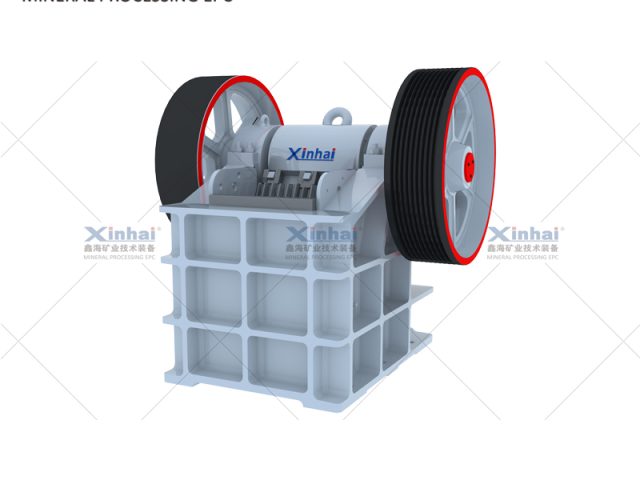
Run-of-mine ore goes through a jaw crusher for primary reduction, then a cone crusher closed with a vibrating screen. Two stages or three, depending on feed top size and how competent your ore is. Nothing exotic here, and it’s the cheapest part of the plant to get right. The wider crushing equipment line covers the sizing duties.
Grinding and classification
A wet ball mill runs closed with a hydrocyclone cluster. The grind target is set by one thing only: measured liberation in your own ore, rather than a handbook figure or whatever the plant down the valley happens to run. Under-grind and you carry composite galena-sphalerite middlings that put lead into the zinc concentrate and zinc into the lead. Over-grind and you make slimes, which coat surfaces, soak up reagent and quietly wreck selectivity. Fine-grained intergrown ore needs a finer product than a coarse one; mineralogy decides that, not the mill supplier. Our grinding equipment section covers the mill options.
Lead circuit
Conditioned pulp enters a rougher-scavenger-cleaner train of mechanical flotation cells. Rougher concentrate is cleaned two or three times; cleaner tailing returns to the head of the cleaner train and scavenger concentrate goes back to rougher feed, so nothing payable leaves the circuit without a second chance at it. Cell count and bank arrangement follow the flotation kinetics measured on your sample, not a nameplate residence time. Where middlings stay stubborn after cleaning, a concentrate regrind ahead of the cleaners usually buys back more grade than bolting on another cleaning stage, because the problem is locked mineral rather than insufficient contact.
Zinc circuit
Activation of the depressed sphalerite needs conditioning time, and it isn’t instant. Short conditioning is one of the commonest reasons zinc recovery lands below what the testwork promised, so the conditioning tank gets sized from measured kinetics rather than a rule of thumb. Lime here does double duty: it sets the operating pH and it depresses pyrite, which means one control loop is serving two objectives and has to be tuned as such rather than trimmed for pH alone. Xinhai’s flotation equipment covers rougher, scavenger and cleaner duty in both circuits, and a packaged flotation plant can be laid out for the two-circuit sequence.
Dewatering and tailings
Each concentrate is thickened in a deep cone thickener and filtered on a filter press to a shippable cake. Moisture is freight. On a long export haul you’re paying ocean rates to move water. Tailings are thickened as well, clarified water returns to the mill, and in a dry region that reclaim circuit matters more than most feasibility studies admit. Our thickening and dewatering range covers both the concentrate duty and the tailings duty.
What your ore decides
- Deposit type. The USGS Mississippi Valley-type deposit model lists sphalerite, galena, pyrite, marcasite, dolomite and calcite as the dominant minerals of MVT ores, and points out that their large grain size makes them easier to process than most other sedimentary rock-hosted ores, with iron sulphide content generally low, typically under five percent. A fine-grained, pyrite-rich sulphide body is a different animal altogether: finer grind, more lime, tighter cleaning, lower tolerance for upsets.
- Reagent scheme. The depressant and activator pair decides how cleanly Pb and Zn split. It comes out of testwork on your ore. Copying a scheme from the mine down the valley is how plants end up re-tendering their reagent system in year two.
- Oxidation. Cerussite and smithsonite don’t respond to standard sulphide collectors. Sulphidisation with sodium sulphide can bring some of them back, or the oxide fraction needs a route of its own. Measure the sulphide-to-oxide ratio before anyone draws a flowsheet.
- Pyrite and iron. Heavy pyrite raises lime demand, complicates zinc selectivity, and shows up again downstream as acid-generation risk in the tailings facility.
- Water chemistry. Recycled process water carries residual reagent and dissolved ions back into the circuit. Run the testwork on the water you’ll actually operate on. Distilled water in a lab beaker flatters every result it touches.
Where the silver goes
Silver usually travels with galena and reports to the lead concentrate, where the smelter pays for it as a by-product. That’s the general case, and it has exceptions worth money. Some ores deport a meaningful share into the zinc concentrate, where terms are thinner or absent entirely. The USGS MVT model lists silver among the byproduct commodities of those deposits and reports it for 34 of the 113 deposits in its compilation: common enough to plan for, variable enough that you have to measure it. Mineralogy plus assay-by-size during testwork shows you where the silver deports, and that answer goes straight into the offtake negotiation. Where silver is the main event rather than the by-product, our silver processing solution covers that route.
Testwork first, steel second
Xinhai was founded in 1997. The group runs a CNAS-accredited laboratory (ISO/IEC 17025) alongside an industrial-scale pilot base. Company figures put the annual load at roughly 200 ore-dressing test programmes across more than 70 ore types. The mine design institute pulls 17 disciplines into a single drawing set: geology, mining, mineral processing, civil, electrical, automation, tailings, water, HVAC, general layout, cost estimating. One team, one flowsheet, one budget, which spares you the argument between three consultants about whose number was wrong.
Testwork buys you defensible numbers instead of borrowed ones. A copper case from our engineering archive makes the point: a 1.5 Mt/a flotation programme in Kazakhstan landed on a grind of 50% passing 200 mesh with one rougher, two scavengers and three cleaners, and that arrangement belongs to that orebody and no other.
On the lead-zinc side, our project record includes a 500 t/d concentrator in Heilongjiang, a 990,000 t/a plant in Inner Mongolia and a 1,100 t/d copper-lead plant in Namibia. Three jobs, three different shapes of circuit. At 500 t/d the flotation section typically sits in a single bank per stage, and the engineering question is how few stages you can get away with while still making two separately saleable products. Inner Mongolia runs roughly six times that throughput, and at that scale the same sequential logic has to be spread across parallel banks, with surge capacity between circuits, automated reagent dosing and enough instrumentation to keep both circuits stable when head grade moves during a shift. Namibia is a different separation again: copper against lead rather than lead against zinc, so the depressant scheme and the flotation order change even though the equipment list looks familiar. The 1,200 t/d fluorite EPC in Italy belongs on this list too. Our archive logs that orebody as a galena-bearing fluorite ore, which puts a sulphide rejection stage in front of a non-sulphide saleable product. It was Xinhai’s first full-scale EPC in Europe and was delivered CE-certified throughout; CE marking is a legal condition for placing this class of equipment on the EU market. Browse the project record, or the Italian fluorite plant for the delivery detail.
Manufacturing sits behind the design work: ball mills to 7 m diameter, flotation cells to 320 m³, thickeners to 100 m, with single-project capacity supported up to 50,000 t/d. For the same selective-separation logic applied to a related sulphide system, read our copper flotation flowsheet guide. If you’d rather hand over the whole scope, from testwork and design through equipment, construction, commissioning and operation, that’s what an EPC+M+O contract is for.
Two lead-zinc ores rarely behave alike. Send a sample and a target, and we’ll size the circuit around what your ore actually does: contact us for an ore test.
Sources
- U.S. Geological Survey, Mineral Commodity Summaries 2025: Lead. Supports the statement that much U.S. lead is recovered as a byproduct at zinc and silver mines, and that lead resources are identified in association with zinc, silver and copper deposits in Australia, China, Ireland, Mexico, Peru, Portugal, Russia and the United States (Alaska).
- U.S. Geological Survey, Mineral Commodity Summaries 2025: Silver. Supports silver being produced mainly as a byproduct or coproduct of base- and precious-metal operations (four silver mines against 31 base- and precious-metal operations in the United States).
- Leach, D.L., and Taylor, R.D., 2009, Mississippi Valley-type lead-zinc deposit model: U.S. Geological Survey Open-File Report 2009-1213. Supports the dominant-mineral list (sphalerite, galena, pyrite, marcasite, dolomite, calcite), the coarse grain size and easier processing note, the generally low iron sulphide content, and silver as a byproduct commodity reported for 34 of 113 deposits.
Where silver carries most of the value and the mine is small, read the lead-silver ore processing plant page, which is written for 100 to 500 t/d turnkey projects.
Frequently Asked Questions
Why float lead before zinc instead of making a bulk concentrate?
Because smelters pay only for their own metal. A lead smelter penalises the zinc in your concentrate, and the zinc smelter returns the favour, so a bulk product gets discounted hard. Differential flotation floats galena first while sphalerite is depressed, then activates the sphalerite and floats it separately, giving you two saleable concentrates instead of one penalised one.
What grade and recovery can lead-zinc flotation achieve?
Nobody can tell you yet. Any supplier quoting grade and recovery before seeing a sample is guessing, and that guess ends up inside a feasibility study that later has to be walked back. Mineralogy, grain size and intergrowth, the sulphide-to-oxide ratio, pyrite content and even the water you'll operate on all move the answer. Bench testwork sets the direction, and a pilot campaign confirms it under continuous conditions with recycled water. Those are the numbers a bankable study should be built on.
What reagents separate lead from zinc?
Zinc sulphate depresses sphalerite while a sulphide collector floats the galena, classically with sodium cyanide alongside it, or a sulphur-dioxide-based scheme where cyanide is restricted. Copper sulphate then reactivates the depressed sphalerite for the zinc circuit, and lime lifts pH to hold pyrite down. Dosages aren't transferable. Conditioning times and reagent addition points get tuned on your own ore in testwork.
Does the silver report to the lead or the zinc concentrate?
Mostly the lead concentrate. Silver associates with galena in most lead-zinc ores and follows it through the lead circuit, where the smelter pays for it as a by-product. The USGS Mississippi Valley-type deposit model lists silver among the byproduct commodities of those deposits. How much of it follows the zinc instead varies with mineralogy, so a mineralogical study plus assay-by-size during testwork is what tells you, and that answer feeds straight into the offtake terms.
Can oxidised lead-zinc ore be floated?
Not with a standard sulphide collector. Cerussite and smithsonite don't respond to one. Sulphidisation with sodium sulphide ahead of flotation recovers part of the oxide fraction; a heavily oxidised orebody usually needs a separate route. Measure the sulphide-to-oxide ratio first.
What is involved in lead zinc ore processing?
Lead zinc ore processing typically involves crushing, grinding, and selective froth flotation. Galena is floated first while sphalerite is depressed with zinc sulphate, then activated with copper sulphate and floated separately. Testwork on your ore sets grade and recovery targets, as mineralogy and reagent schemes vary.
Send your ore data for a flowsheet and quote
Ore type, grade, target capacity and country are enough for a first scoped reply.
Related projects
500,000 t/a Wollastonite Mining — Jiangxi, China
Standardised mining practice implemented across the operation, with ore dilution held strictly below 5%
Read case →
3,500 t/d Iron Ore Plant — Mongolia
Primary iron concentrate at ≥65% Fe with a yield of about 31%, plus a secondary concentrate…
Read case →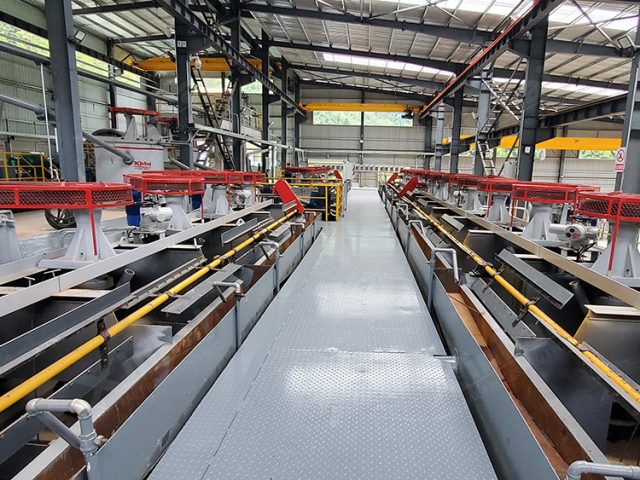
1,200 t/d Fluorite Plant — Italy
Xinhai's first full-scale EPC project in Europe, delivered with CE certification across the whole scope.
Read case →