Silver ore rarely looks like shiny metal, so field identification starts with dark sulphides and tarnish.
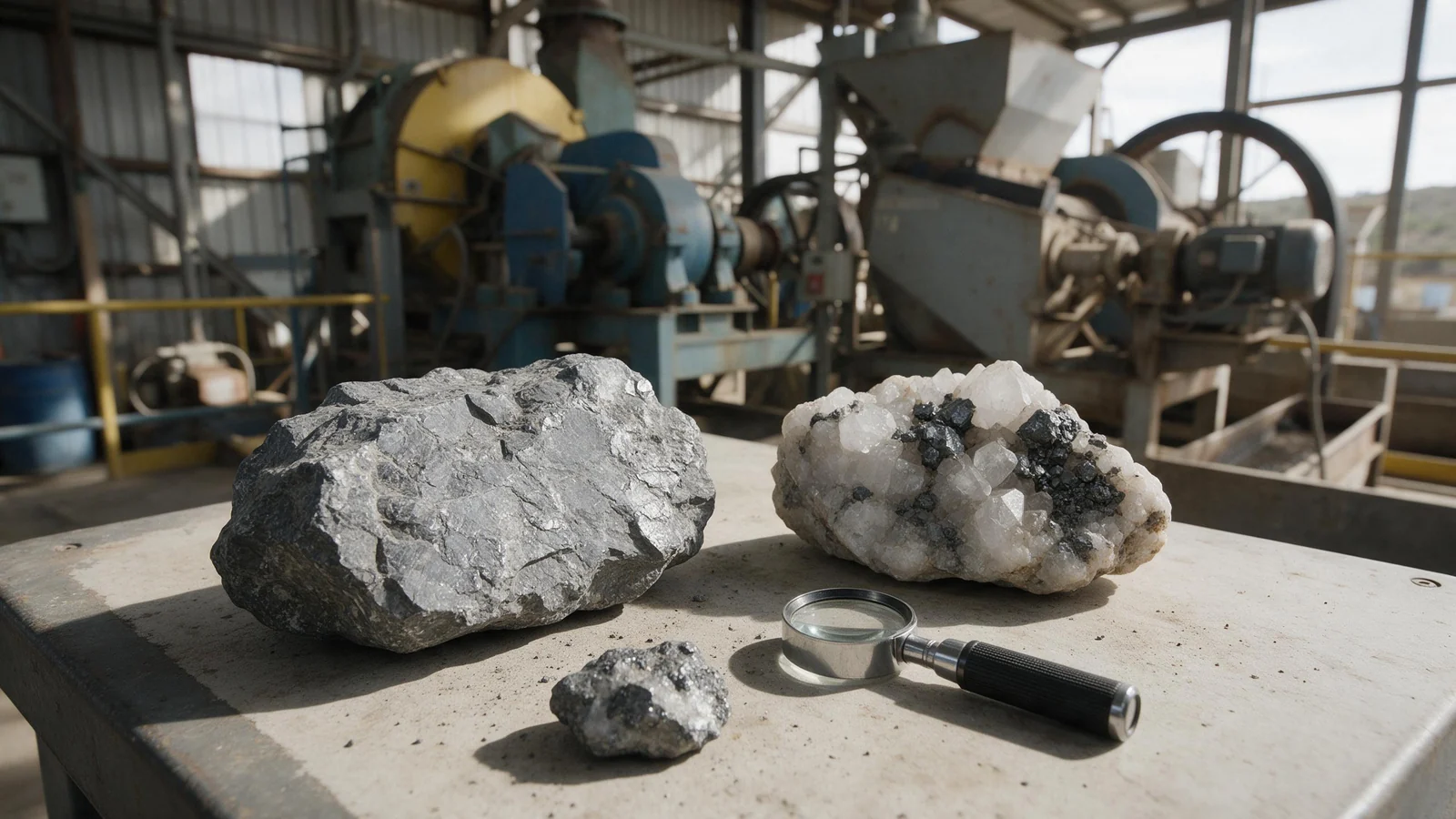
Say a mine owner asks, “I think I’ve found silver ore. How do I identify it?” The honest answer? How to identify silver ore in the field starts with grey, black and brown minerals. Not shiny metal. Not shiny metal. Silver rarely shows up as bright metal. It hides in dark sulphides and a few oxidised minerals. You’ll need field observation first, then a lab assay. Don’t decide before that.
What silver ore actually looks like in the field
Native silver exists, but it’s the exception. It forms wires, flakes and dendritic masses. Fresh surfaces can look silver white. They tarnish fast to dark grey or black. That’s one of your best field clues. Argentite and acanthite are silver sulphides. They look sooty black and often crumbly. Cerargyrite, sometimes called horn silver, is waxy grey-green to brown. It forms in oxidised zones. Tetrahedrite is a steel-grey sulphosalt. It can carry silver. And the most common host is galena, lead sulphide, described by the U.S. Department of Energy as PbS. If silver replaces enough lead in the galena structure, geologists call it argentiferous galena. Simple enough.
Don’t expect shiny white metal. Most silver ore is dark and heavy. The table below summarises what to look for. It also lists what each mineral is often confused with.
Common silver minerals in the field
| Mineral | Field appearance | Quick check | Often mistaken for |
|---|---|---|---|
| Native silver | Wires, flakes or dendritic masses; tarnishes dark grey to black | Malleable; a knife blade flattens it | Tin, solder, mica |
| Argentite/acanthite | Sooty black, soft, sectile | Dark grey streak; can be cut with a knife | Manganese oxides, coal |
| Cerargyrite (horn silver) | Waxy grey-green to brown, soft | Very soft; darkens in light | Wax, clay |
| Tetrahedrite | Steel-grey, brittle, metallic | Grey-black streak; brittle, not malleable | Galena, sphalerite |
| Silver-bearing galena | Bright metallic lead-grey, cubic cleavage | Streak grey-black; heavy; cubic cleavage | Arsenopyrite, stibnite |
A hand lens helps. You still won’t get a grade.
Field signs that suggest silver mineralisation
Silver doesn’t usually travel alone. Lead and zinc ores are usually found together with gold and silver, as the U.S. Department of Energy notes. In the field, look for heavy dark metallic minerals in quartz or carbonate veins. Galena and sphalerite are classic companions. Sphalerite is zinc sulphide. Black sphalerite may carry enough iron to look nearly pitch black. Polymetallic replacement deposits, which often sit distal from porphyry copper systems, can contain galena, sphalerite, tetrahedrite and other silver sulphosalts, according to the U.S. Geological Survey. You’ll see iron and manganese oxide staining where sulphides weathered near surface. That staining doesn’t prove silver. But it marks a hydrothermal system worth sampling.
Hydrothermal veins in folded or fractured sedimentary and metamorphic rock are the usual setting. The minerals are heavy. A pan or heft test helps separate them from quartz. But weight alone doesn’t identify silver. It narrows things down.
Simple field checks and where they mislead
Streak is useful. Rub the mineral on unglazed porcelain. Galena gives a grey-black streak. Sphalerite gives pale yellow to brown. Native silver gives silver-white that tarnishes. Hardness separates soft silver minerals from harder impostors. You can scratch argentite with a knife. You can’t easily scratch arsenopyrite. Malleability is another clue. Native silver flattens under a knife point. Brittle sulphides crumble.
These checks mislead in two common ways. First, black crumbly material is often manganese dioxide, not silver sulphide. It looks similar in a weathered outcrop. Leaves a black streak too. Second, visual identification can’t confirm grade. It can’t even confirm payable silver presence. A rock can hold a little silver in galena and still be worthless at current prices. Another rock with no visible silver mineral can carry important values in solid solution.
Don’t trust a vinegar test either. Acetic acid fizzes on carbonates like calcite. Not on silver sulphides. So a fizz or no fizz tells you nothing about silver. Keep field checks where they belong. They narrow the possibilities. They don’t close the question.
Why only fire assay and a lab can confirm silver
Fire assay is the reference method for silver and gold. It fuses a weighed sample with lead flux. Collects precious metals in a lead button. Then cupels that button to leave a silver bead. That bead gets weighed. The result is reported in grams per tonne or troy ounces per short ton. Not a yes or no. You get a number.
For concentrates, ISO 10378 describes a fire assay gravimetric and flame atomic absorption spectrometric method for silver in copper sulphide concentrates, applicable from 25 g/t to 1,500 g/t. ISO 15248 does the same for zinc sulphide concentrates. A lab report gives more than grade. It should include multi-element data for lead, zinc, copper, silver, gold, sulphur, iron, arsenic and antimony. Mineralogy and phase analysis identify which silver mineral carries the value. Could be argentite, tetrahedrite, silver-bearing galena, or something else. That matters. Each mineral responds differently to flotation, cyanidation or leaching.
Xinhai’s research institute runs a CNAS-accredited lab. About 5,000 element analyses per month. That supports this kind of testwork. You can read more about silver processing routes on the silver processing page.
From rock sample to process decision: assays, mineralogy, flotation tests
A positive field identification is just the start. Collect representative samples across the mineralised zone. Do that before testing. Not one grab sample from the richest-looking piece. Take a series of samples that reflect the range of mineralisation, wall rock and alteration. Cut channels across veins. Include massive and disseminated sulphide. Avoid cherry-picking high grade. A sample that lies about the deposit is worse than none at all.
A full test programme starts with fire assay for silver and gold. Plus multi-element analysis for lead, zinc, copper, sulphur, iron, arsenic and antimony. The mineralogy report identifies silver carriers. Their grain size and liberation characteristics matter too. Without that, you don’t know if silver will float with lead, deport to zinc concentrate, or report to tailings. Bench flotation tests come next. They use a few kilograms of prepared sample. You test reagent schemes, grind size and flotation circuit configuration. They’re not optional before any plant or equipment talk. If you’re ready to look at extraction routes, the silver extraction process page covers the main options.
What a lead-silver processing plant needs to know
If mineralogy shows silver mostly in galena, you’re likely looking at a lead flotation circuit. Small plants typically use two-stage crushing. Then a ball mill in closed circuit with a hydrocyclone. Then a lead rougher and cleaner circuit. For small lead-silver plants, target the ball mill circuit at a P80 between 75 and 150 micrometres. Depends on liberation. Silver usually reports to the lead concentrate. That’s convenient, because lead smelters pay for silver. If zinc is present in payable grades, you can float it separately in a second circuit. For concentrate dewatering, you’ll usually use a thickener then a filter.
The exact equipment list depends on ore hardness, liberation size, clay content and water chemistry. Xinhai reports a 500 t/d silver flotation plant with 83.95% silver recovery. That shows what a well-run lead-silver circuit can do with a specific ore. You’ll find more detail on the lead-silver processing plant solution page.
Field signs get you interested. Assays and testwork get you a flowsheet.
Frequently Asked Questions
Can I test silver ore with vinegar?
No. Vinegar is acetic acid. It fizzes on carbonate minerals like calcite, but it won't react with silver sulphides or most silver-bearing minerals. A fizz, or the absence of one, tells you nothing about silver content. Only fire assay and a laboratory report can confirm silver presence and grade.
What metal is mistaken for silver?
Mica, galena, arsenopyrite, specular hematite and even pyrite are commonly mistaken for silver. Especially when weathered or seen in poor light. Native silver tarnishes dark grey or black, so it's often not shiny. Field checks like streak, hardness and malleability help separate candidates. But a lab assay is the only reliable confirmation.
What does raw silver ore look like?
Raw silver ore rarely shows bright metal. It more often appears as dark grey to sooty black sulphides, waxy grey-green horn silver, or silver-bearing galena with a metallic lead-grey streak. Native silver occurs as wires, flakes or dendritic masses that tarnish black.
How do I know if I have found silver ore?
You don't know until a fire assay and mineralogy report confirm it. Field signs such as heavy dark sulphides in quartz veins, association with galena and sphalerite, and iron staining are suggestive. But visual identification cannot confirm payable silver. Collect representative samples and send them to an accredited laboratory.